Make Business Information Easier to Access: Visitor Directions, Payments, and Company Details with Proezi
Introduction
A business shares information with many different people. Visitors need to know where to enter. Customers need clear payment instructions. Suppliers may request company registration details. These requests often arrive through calls, emails, and messages. Staff members then repeat the same information throughout the day. This can create confusion when details change. A better approach is to organize important information in one place. Businesses can create separate pages for different needs. They can share these pages through links and QR codes. Proezi helps businesses publish visitor, payment, and business identity information online. People can open shared pages through their browsers. They do not need to install an app or create an account. This gives businesses a simple way to distribute useful information.
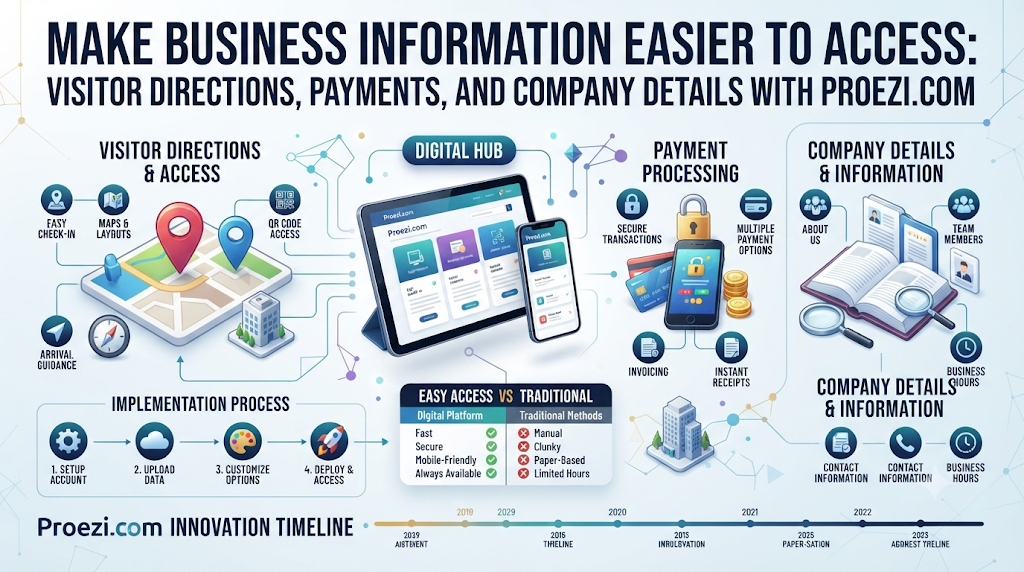
Organize Business Information Around Different Needs
Not everyone needs the same business information. A visitor needs directions. A customer may need payment details. A supplier may want company registration information.
Sending everything in one message can make important details difficult to find. Separate information pages offer a clearer approach. Each page can focus on one purpose.
Businesses can organize information into three main groups:
- Visitor information: Addresses, entrances, parking, and arrival instructions.
- Payment information: Bank details, UPI information, and transfer references.
- Business identity: Registered names, registration identifiers, and tax numbers.
This structure helps people find relevant details quickly. It also makes updates easier to manage. Staff can direct people to the correct page instead of writing the same instructions repeatedly.
Proezi.com supports this approach through reusable links and QR codes. Businesses can publish different information pages and share them with the people who need them.
Give Visitors Better Directions Before They Arrive
A business address does not always explain how to reach the correct destination. Large buildings may have several gates. Shopping complexes may contain multiple entrances. Clinics may have separate reception areas and departments.
Visitors need more than a street name. They need practical instructions for the final part of their journey.
QR code directions for visitors provide a direct way to open arrival information. A visitor scans a printed code and opens the linked page. The page can explain where to go after reaching the property.
Useful details include:
- Building name and full address.
- Nearby landmarks.
- Visitor parking location.
- Correct entrance and gate.
- Reception desk location.
- Elevator and floor information.
- Department or room details.
- Contact information for assistance.
Businesses can place QR codes on appointment messages, invitations, reception signs, and entry notices. They should test each code before distributing it.
Proezi.com allows businesses to publish QR code directions for visitors through reusable pages and QR codes. This can reduce the need to send lengthy directions separately.
Digital Visitor Arrival Instructions for Every Step
digital visitor arrival instructions describe what a person should do after reaching a business location. They turn a confusing arrival into a series of clear steps.
A useful instruction page should follow the visitor’s journey. Start with the nearby road or landmark. Then explain the correct gate, entrance, reception area, and destination.
For example, a visitor might need to:
- Turn toward the building’s main driveway.
- Use the marked visitor parking area.
- Walk toward the reception entrance.
- Report at the front desk.
- Take the elevator to the required floor.
- Follow the signs to the meeting room.
Different visitors may need different instructions. Drivers may use a vehicle gate. Pedestrians may enter through another side. Delivery workers may need a service entrance.
Proezi.com supports pages that can include photographs, map coordinates, landmarks, and emergency contact buttons. Businesses can use these details to prepare digital visitor arrival instructions for their locations.
They should review the information whenever access arrangements change. A temporary entrance closure can make old directions incorrect.
Choose Visitor Wayfinding Software That Fits the Property
visitor wayfinding software helps people understand how to reach a destination within a property. It can support directions across buildings, floors, departments, and rooms.
The right solution depends on the location. A small office may need basic entrance details. A large hospital may need separate instructions for several departments.
Before selecting visitor wayfinding software, businesses should consider these points:
- Ease of use: Visitors should understand the page without special training.
- Clear routes: Instructions should explain each important turn.
- Visual support: Photographs can show recognizable entrances.
- Different access needs: Routes should explain available step-free access.
- Temporary notices: Pages should communicate access changes.
- Contact options: Visitors should know where to request help.
A business should also consider who will maintain the information. Even useful software becomes less effective when details become outdated.
Proezi.com provides web-based information pages that businesses can share through links and QR codes. Its visitor pages can organize arrival details for different visitor groups.
When reviewing visitor wayfinding software, businesses should focus on the actual needs of their buildings. More features do not always mean better directions.
Build a Useful How to Find Us Page for Business
A how to find us page for business gives people practical information about reaching a company. It should answer common arrival questions before someone starts travelling.
Begin with the full address. Add a map link for outdoor travel. Explain the final route from the nearby road to the correct entrance.
A useful page can include:
- Business name and complete address.
- Nearby transport points or landmarks.
- Map links for outdoor navigation.
- Parking arrangements.
- Entrance photographs.
- Reception and visitor check-in details.
- Floor, department, and room information.
- Contact details for arrival questions.
A how to find us page for business should avoid long, confusing directions. Use short steps and familiar words. Keep important entrance details easy to locate.
Businesses with several branches should create location-specific information. A visitor should not mistake one branch for another.
Proezi.com can help businesses publish and share these pages. Reusable links and QR codes make it easier to include the information in appointment messages and other business communications.
The business must check that its address, photographs, and instructions remain accurate.
Explain Parking and Entrance Directions for Visitors
parking and entrance directions for visitors help people choose the correct place to park and enter. They are especially useful when a property has several gates or parking areas.
A visitor may reach the right building but still enter through the wrong door. Clear instructions can prevent this confusion.
Businesses should explain:
- Which parking area visitors should use.
- Whether parking is inside or outside the property.
- Which gate allows visitor entry.
- Where taxis should stop.
- Which entrance leads to reception.
- Where delivery vehicles should report.
- Whether a step-free route is available.
Use photographs to identify gates and entrances. Add nearby signs or landmarks when they help people recognize the location.
For a large property, separate instructions may be needed for different groups. parking and entrance directions for visitors should not send delivery workers through a guest entrance.
Proezi.com pages can include photographs, landmarks, and route details. Businesses can use these features to explain arrival arrangements. They should also publish temporary notices when parking or entrance access changes.
Make Event Venue Directions Easier to Follow
An event location may look simple on an invitation. However, guests may still struggle to find the correct hall or entry point.
An event venue directions QR code gives guests a quick way to open event arrival details. Organizers can include it in invitations, registration messages, tickets, or printed signs.
The linked information can explain:
- Venue address and nearby landmarks.
- Guest entrance and registration desk.
- Parking and drop-off arrangements.
- Hall or conference room location.
- Accessible entrance information.
- Vendor and delivery access.
- Event contact details.
Organizers should prepare instructions for each group. Guests may need the main entrance. Speakers may need a separate check-in point. Vendors may require loading access.
An event venue directions QR code can also direct guests to updated access notices. Organizers should update the page if an entrance changes.
Proezi.com can help event teams publish visitor information through reusable pages and QR codes. Guests can open the shared information in their browsers without installing an app.
Organizers should test the code and page before adding them to event materials.
Improve Last Mile Navigation for Businesses
last mile navigation for businesses focuses on the final part of a journey. It explains how someone reaches the exact entrance or room after arriving nearby.
Outdoor map applications can help people travel along public roads. However, they may not explain private driveways, internal gates, or building entrances.
Businesses can provide a map link for the main journey. They can then add written instructions for the final approach.
For example, directions might explain which driveway to use, where to turn, and which entrance leads to reception.
Useful supporting details include:
- A recognizable building photograph.
- Nearby road or gate landmarks.
- Correct parking information.
- A walking route from the parking area.
- Reception and elevator locations.
- Floor and room instructions.
last mile navigation for businesses can be useful for offices, clinics, hotels, event spaces, and warehouses. It can also help delivery teams reach the correct service entrance.
Proezi.com allows businesses to publish final arrival details through information pages. Businesses remain responsible for checking their routes and updating instructions when the property changes.
Share Bank Details With Customers Through Clear Payment Pages
Customers sometimes request bank information before making a payment. Businesses may send the same account details through multiple messages.
A dedicated payment information page can keep these instructions organized.
To share bank details with customers, businesses can prepare a page containing the necessary transfer information. They can distribute it through a reusable link or QR code.
Depending on the supported options, a page may include:
- Bank account information.
- Bank transfer instructions.
- Payment reference details.
- UPI information.
- PayPal details.
- Supported international payment identifiers.
- Copyable payment details.
Businesses should check all information before publishing it. They should never include passwords, PINs, or card security codes.
Customers should confirm the recipient and payment amount before transferring money. For a large first payment, they should confirm account details through another trusted channel.
Proezi.com provides pages for sharing payment information. It does not act as a bank, payment gateway, wallet, or payment processor. It does not process, collect, or transfer money.
When businesses share bank details with customers, they remain responsible for the accuracy of the information. Proezi.com cannot prevent fraud or guarantee payment safety.
Explain UPI QR Code Payment Page Information
A UPI QR code payment page provides customers with UPI payment information. UPI is a payment system used in India. Customers use their own payment applications to make transfers.
A business may display its UPI details alongside payment instructions. It may also provide a payment reference to help identify a transaction.
A useful page can contain:
- UPI information.
- A UPI QR code.
- Payment purpose or reference.
- Copyable payment details.
- Business contact information.
- Basic transfer instructions.
Customers should check the displayed recipient details before making a payment. They should use their own payment application to complete the transaction.
A UPI QR code payment page does not mean that the page itself receives money. Proezi.com only provides a way to publish and share payment information. It does not collect or transfer payments.
Businesses should check their UPI information regularly. If payment details change, they should update the page and replace outdated printed materials.
Share Business Registration Details Online
Suppliers and business partners may request company identity information. They may need a registered business name, company registration identifier, or tax number.
To share business registration details online, a business can publish the relevant information on a dedicated page. This gives people one place to access the details.
Before publishing, businesses should:
- Check the registered business name.
- Review each registration identifier.
- Check the tax number for typing errors.
- Include only relevant business information.
- Review the page when company details change.
Proezi.com supports business identity information pages. It can check identifiers for format and checksum. A checksum is a calculation used to check whether information follows a particular structure.
This does not confirm that an identifier belongs to the business. It does not verify registration status with government authorities.
Businesses should not describe these checks as official verification. When they share business registration details online, they remain responsible for the accuracy of the information.
Rules differ by country. Check local rules.
Business Information Types and Their Uses
Different pages serve different communication needs. Businesses should choose the information that matches the purpose of each page.
| Information Type | What to Include | Who It Helps |
|---|---|---|
| Visitor arrival | Address, gates, entrances, and reception | Guests and appointment visitors |
| Parking access | Parking areas, drop-off points, and vehicle entrances | Drivers and delivery teams |
| Indoor directions | Elevators, floors, departments, and rooms | Visitors and new employees |
| Event access | Venue entrance, registration desk, and hall details | Guests, speakers, and vendors |
| Payment details | Bank information and transfer references | Customers and clients |
| UPI information | UPI details and payment QR code | Customers in India |
| Business identity | Registered name and business identifiers | Suppliers and business partners |
A Practical Example: A Community Sports and Activity Center
Consider a fictional community sports center with indoor courts and activity rooms. New members often arrive at the wrong entrance. Parents also ask staff where to park and report.
The center prepares a visitor information page using Proezi.com. It adds the main address, a photograph of the correct gate, and parking instructions. Another section explains how to reach the reception desk and indoor courts.
The center shares the page through a QR code on membership messages. Visitors can open it before leaving home. Staff can also direct callers to the same page.
The business creates a separate payment information page. It includes the necessary bank transfer details and payment references. Customers complete transfers through their own banking applications.
A third page displays the center’s business identity information. The center checks its details before publishing them. Proezi.com checks identifier format and checksum only. It does not verify ownership or registration status with government authorities.
This fictional example shows how separate pages can support different communication needs. The center must still review its information whenever arrangements change.
Common Problems to Avoid When Publishing Business Information
A digital page is useful only when its information is clear and current. Small mistakes can confuse visitors and customers.
Businesses should avoid these common problems:
- Incomplete location details: Add the full address and correct entrance.
- Unclear parking information: Identify the visitor parking area.
- Missing indoor instructions: Explain where visitors should report.
- Unhelpful photographs: Use images that clearly identify the location.
- Incorrect QR codes: Test each code before sharing it.
- Outdated payment details: Review account information before publishing.
- Unnecessary private information: Never publish passwords or payment security codes.
- Unclear identity claims: Do not describe format checks as government verification.
- Missing access notices: Explain temporary entrance or parking changes.
- No regular review: Assign someone to maintain the pages.
Businesses should also make sure each page has a clear purpose. A visitor page should not overwhelm guests with unrelated payment details.
When teams publish QR code directions for visitors, they should check that the code opens the intended page. When they publish payment or identity information, they should review every detail before distribution.
How Proezi Supports Information Sharing
Proezi.com is a web-based platform for publishing and sharing business information. It supports visitor arrival pages, payment information pages, and business identity pages.
Businesses can share these pages through reusable links and QR codes. Visitors can open them in a browser without installing an app or creating an account.
Visitor information can include parking, entrances, gates, reception, elevators, floors, and rooms. Businesses can add annotated photographs, map coordinates, landmarks, and emergency contact buttons. Separate instructions can support drivers, pedestrians, taxi passengers, delivery teams, and visitors needing step-free access.
Businesses can also publish bank transfer details, UPI information, PayPal details, supported international payment identifiers, and payment references. Proezi.com does not process, collect, or transfer payments. Customers pay through their own bank or payment application.
Business identity pages can display registered names, registration identifiers, and tax numbers. Identifier checks cover format and checksum only. They do not confirm ownership or government registration status.
The platform also describes printable signs, arrival cards, website-embedded cards, multilingual directions, and previously cached offline directions. The site says features are free during early access. Details can change.
Businesses remain responsible for the information they publish. Proezi.com cannot guarantee that directions are correct or prevent payment fraud.
Frequently Asked Questions
1. Can visitors open Proezi.com information without downloading an application?
Yes. Visitors can open shared Proezi.com pages through their web browsers. They do not need to install an application or create an account. Businesses can distribute the pages through reusable links and QR codes. Visitors should still check that they have opened the correct information page.
2. What makes QR code directions for visitors useful for appointment-based businesses?
Appointment-based businesses often receive repeated questions about entrances and parking. QR code directions for visitors give guests a way to access these details before travelling. Staff can include the code in appointment messages. Businesses should keep the linked instructions accurate.
3. Can visitor wayfinding software help people reach a particular department?
Yes. Visitor wayfinding software can provide directions to departments, floors, and rooms. This is useful in properties with several internal destinations. Businesses should explain the route from the entrance to the final location. Photographs and landmarks can make instructions easier to follow.
4. Should digital visitor arrival instructions be different for suppliers and customers?
They may need to be different. Customers usually need the visitor entrance and reception details. Suppliers may need delivery access or a service gate. Digital visitor arrival instructions can explain these separate routes. Businesses should make each page relevant to its intended audience.
5. What should a how to find us page for business say about public transport?
A how to find us page for business can mention nearby transport points when useful. It may identify a bus stop, railway station, or recognizable landmark. The business should avoid unsupported travel claims. Visitors can use a map application to plan their outdoor journey.
6. Why should businesses explain parking and entrance directions for visitors separately?
Parking and entrance information answer different questions. A driver may know where to park but still choose the wrong building entrance. Parking and entrance directions for visitors should explain both steps. Separate photographs or landmarks can help people recognize the correct locations.
7. Can an event venue directions QR code be included on printed invitations?
Yes. Organizers can print an event venue directions QR code on invitations, tickets, or event signs. Guests can scan it to open the arrival information. Organizers should test the printed code and check the page before distributing event materials.
8. How can last mile navigation for businesses support delivery teams?
Last mile navigation for businesses can explain the final route to a delivery entrance. It may identify a service gate, loading area, or contact point. These details help drivers understand where to report. Businesses must check that delivery instructions match current access arrangements.
9. Does a business need a payment gateway to share bank details with customers through Proezi.com?
No. Businesses can share bank details with customers through a Proezi.com information page. The platform does not process or transfer money. Customers complete payments using their own bank or payment application. Businesses should confirm that their published account information is correct.
10. Does Proezi.com officially verify details when businesses share business registration details online?
No. Businesses can share business registration details online through an identity information page. Proezi.com checks identifier format and checksum only. It does not confirm ownership or registration status with government authorities. Businesses should check their details with the relevant authority when needed.
Final Thoughts
Business communication becomes easier when information has a clear structure. Visitors need practical arrival instructions. Customers need accurate payment details. Suppliers may need company identity information. Separate pages can serve these different purposes. Reusable links and QR codes make sharing straightforward. Proezi.com helps businesses publish these details through browser-based information pages. People can access shared pages without installing an app or creating an account. Businesses must review their pages regularly. They should correct outdated details and avoid unsupported verification claims. Clear information helps people understand what to do next.
Leave a Reply