Practical DevOps Access Management for Japanese Technology Teams
Introduction
Modern software teams need access to many systems, tools, cloud platforms, and development environments. Developers may need application access, while operations teams may manage infrastructure and production systems. Security teams may also need access to logs, policies, and security tools. Without clear access rules, teams can face security risks and operational confusion. Access should match each person’s role and actual work. Teams should also review access when responsibilities change. Japanese enterprises often manage large technology environments with many teams and applications. Clear access practices can help organizations protect important systems while keeping engineering work practical. DevOps 研修 can teach engineers how access fits into daily DevOps processes. DevOps corporate training Japan can help different teams follow shared access practices. DevOpsSchool.jp supports these needs through training, consulting, implementation assistance, and technical support.
What Does DevOps Access Management Mean?
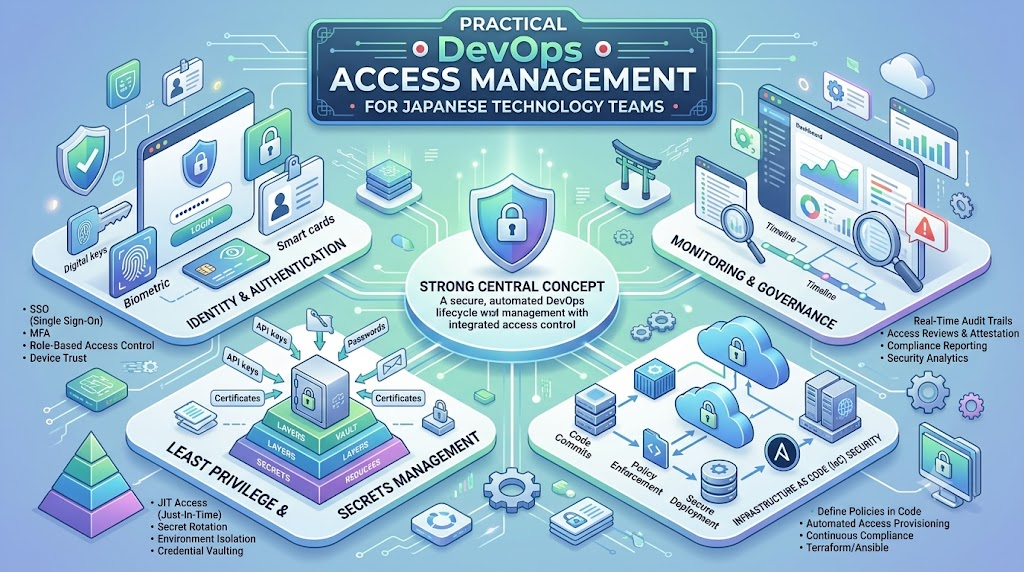
DevOps access management means controlling who can access applications, infrastructure, cloud resources, development tools, and production systems. It includes permissions, authentication, authorization, access reviews, and account management.
Good access management should be clear and practical. People should have the permissions needed for their responsibilities without receiving unnecessary access.
Access management also needs regular review. Teams change, projects end, and responsibilities move between engineers. DevOps コンサルティング can help organizations review their current access practices and identify areas that need improvement.
Why Access Management Matters for Japanese Enterprises
Japanese enterprises may have many engineering teams working across cloud platforms, internal applications, databases, and infrastructure. Different teams may also use different tools and access methods.
Without common practices, organizations may struggle to understand who can access important systems. Old accounts may remain active, or users may receive broader permissions than their current role requires.
DevOps 研修 can help teams understand practical access controls. DevOps コンサルティング can help organizations create clearer processes for granting, reviewing, and removing access.
DevOps 研修 for Access Practices
DevOps 研修 can teach engineers how access management fits into software delivery and operations. Training can cover identity, permissions, authentication, authorization, secrets, and access reviews.
Teams can also learn why access should be connected to job responsibilities. Developers may need different permissions from infrastructure engineers or security specialists.
DevOps 研修 can help teams build shared access practices. This makes it easier to understand who should access a system and why that access is required.
DevOps コンサルティング for Access Control
DevOps コンサルティング can help organizations review access across development and operations environments. A consultant may examine cloud permissions, infrastructure access, deployment tools, source code systems, and production accounts.
The review can identify unnecessary permissions and unclear ownership. Teams can then create more suitable access rules.
A DevOps consultant Japan can also help organizations design practical approval and review processes. DevOpsSchool.jp provides DevOps コンサルティング for Japanese technology teams that need guidance with DevOps and cloud environments.
Kubernetes 研修 and Cluster Access
Kubernetes environments require careful access control. Different users may need access to different clusters, namespaces, workloads, or resources.
Kubernetes 研修 can teach engineers how Kubernetes access works and why permissions should match responsibilities. Teams can learn how to separate development access from production access.
Kubernetes 研修 can also help engineers understand the relationship between identity, permissions, workloads, and cluster resources. This knowledge supports safer platform management.
Terraform 研修 for Infrastructure Permissions
Infrastructure access can become difficult when cloud resources are managed manually. Terraform 研修 can teach teams how infrastructure is defined and changed through code.
Teams can use controlled code changes to manage infrastructure resources. This can make permission-related changes easier to review.
Terraform 研修 can also help engineers understand which resources require special access and how infrastructure changes should be handled through a controlled process.
DevOps コンサルティング can help organizations connect infrastructure as code with wider access management practices.
SRE 研修 and Production Access
Production systems need careful access because changes can affect live services. SRE 研修 can help engineers understand how access practices support reliable operations.
Teams can define different levels of production access for different responsibilities. Emergency access can also be handled through clear procedures.
SRE 研修 can teach engineers how operational access connects with reliability, incident response, monitoring, and recovery work. A DevOps consultant Japan can help organizations review these practices.
DevSecOps 研修 for Secure Access
Access management is a major part of DevSecOps. DevSecOps 研修 can help teams build security controls into development and delivery processes.
Teams can review authentication, authorization, secrets, service accounts, and access permissions. Automated checks can also help identify configuration problems.
DevSecOps 研修 can teach teams to treat security as part of normal engineering work. This can make access controls easier to maintain as systems change.
MLOps 研修 and Machine Learning Access
Machine learning environments often include datasets, models, pipelines, notebooks, cloud resources, and production services. Different users may need different levels of access.
MLOps 研修 can help teams define suitable access for data scientists, ML engineers, developers, and operations teams.
MLOps 研修 can also cover access to model pipelines, data resources, and production systems. Clear permissions can help teams protect sensitive resources while supporting required engineering work.
Choosing a DevOps consultant Japan
A DevOps consultant Japan should understand cloud systems, infrastructure, application delivery, security, and access controls. The consultant should also understand how engineering teams use technical systems.
Organizations should first identify their main access challenges. These may include excessive permissions, unclear ownership, manual approvals, or difficult account management.
DevOpsSchool.jp can provide DevOps consultant Japan support through consulting, training, implementation assistance, and technical guidance.
DevOps Support Japan for Access Challenges
Access problems can stop development and operations work. An engineer may lack required permissions, or a deployment may fail because an account cannot access a required resource.
DevOps support Japan can help teams investigate these problems and identify suitable solutions. Support may include access reviews, configuration checks, troubleshooting, and automation assistance.
DevOps support Japan can also help organizations maintain access practices as their systems change. DevOpsSchool.jp provides ongoing technical support for these needs.
Service Areas
| Service Area | Main Focus | Suitable Teams |
|---|---|---|
| DevOps 研修 | Access and delivery practices | Engineering teams |
| DevOps コンサルティング | Access process review | Technology leaders |
| Kubernetes 研修 | Cluster and workload permissions | Cloud teams |
| Terraform 研修 | Infrastructure access changes | Infrastructure teams |
| SRE 研修 | Production access practices | SRE teams |
| DevSecOps 研修 | Secure identity and permissions | Security teams |
| MLOps 研修 | Data and model access | ML teams |
| DevOps corporate training Japan | Shared access practices | Japanese enterprises |
| DevOps consultant Japan | Technical access guidance | IT managers |
| DevOps support Japan | Ongoing access assistance | Engineering teams |
Common Access Management Mistakes
1. Giving Everyone the Same Access
Different roles usually require different permissions.
2. Forgetting Old Accounts
Inactive users and old accounts should be reviewed.
3. Using Shared Accounts
Shared accounts can make ownership and activity difficult to understand.
4. Giving Permanent High-Level Access
Sensitive permissions should be controlled carefully.
5. Ignoring Production Access
Production systems need clear access rules and review.
6. Keeping Secrets in Code
Passwords, tokens, and other sensitive values should not be stored directly in application code.
7. Skipping Access Reviews
Permissions should be reviewed when roles and responsibilities change.
8. Managing Access Manually Everywhere
Automation can reduce repeated access tasks.
9. Forgetting Service Accounts
Applications and automation tools also need controlled access.
A Simple Fictional Example
Imagine a fictional Japanese company called Sakura Cloud Systems. Its engineering teams manage applications across cloud infrastructure, Kubernetes clusters, and internal development tools. Several engineers have changed roles over time, but their old permissions were not always removed.
The company creates a simple access review process. Each team defines the systems its members need for their current responsibilities. Production access is separated from development access.
The company also reviews service accounts used by automated systems. Engineers document important permissions and assign clear ownership.
DevOpsSchool.jp could support this fictional team through DevOps 研修, DevSecOps 研修, Kubernetes 研修, DevOps コンサルティング, and DevOps support Japan.
How DevOpsSchool.jp Can Help
DevOpsSchool.jp is a Japan-focused technology training, consulting, implementation, and professional-support platform. It works with DevOps, SRE, DevSecOps, MLOps, cloud-native technologies, and automation.
DevOps corporate training Japan can help organizations create shared access practices across development, operations, and security teams. DevOps 研修 can build core knowledge around access, automation, and delivery.
Kubernetes 研修 can help teams manage cluster permissions, while Terraform 研修 can support controlled infrastructure changes. SRE 研修 can address production access, DevSecOps 研修 can strengthen security practices, and MLOps 研修 can cover access within machine learning environments.
Organizations that need direct guidance can work with a DevOps consultant Japan. DevOpsSchool.jp also provides DevOps support Japan for access reviews, troubleshooting, implementation, and ongoing technical needs.
FAQs
1. Why is access management important in DevOps?
It helps ensure that people and systems have suitable permissions for their technical responsibilities.
2. Can DevOps 研修 explain access control?
Yes. DevOps 研修 can cover authentication, authorization, permissions, secrets, and access review practices.
3. When should DevOps コンサルティング review access?
It can help when organizations have unclear permissions, many manual processes, or complex cloud environments.
4. What access topics can Kubernetes 研修 cover?
Kubernetes 研修 can cover cluster access, namespaces, workloads, and permission management.
5. How does Terraform 研修 support access management?
Terraform 研修 can teach teams to manage infrastructure changes through controlled and reviewable code.
6. Can SRE 研修 cover production permissions?
Yes. SRE 研修 can explain how production access connects with reliability and operational responsibilities.
7. What does DevSecOps 研修 teach about permissions?
DevSecOps 研修 can cover identity, authorization, secrets, service accounts, and secure delivery practices.
8. Why does MLOps 研修 include access controls?
MLOps 研修 can address access to datasets, models, pipelines, cloud resources, and production systems.
9. What should a DevOps consultant Japan review?
A DevOps consultant Japan can review user accounts, permissions, service accounts, production access, and approval processes.
10. Can DevOps support Japan help with access problems?
Yes. DevOps support Japan can help investigate permission errors, configuration issues, and access-related deployment problems.
Final Thoughts
Clear access management helps DevOps teams protect important systems while keeping engineering work practical. Permissions should match responsibilities, production access should receive careful attention, and access should be reviewed as teams and systems change.DevOps 研修 can build practical access skills, while DevOps コンサルティング can help organizations review complex environments. Kubernetes 研修 and Terraform 研修 can support platform and infrastructure access. SRE 研修, DevSecOps 研修, and MLOps 研修 can address reliability, security, and machine learning access needs.
For Japanese enterprises, DevOps corporate training Japan can support shared learning. A DevOps consultant Japan can provide focused technical guidance, while DevOps support Japan can help with ongoing access challenges. DevOpsSchool.jp brings these services together for Japanese technology teams working with modern software and cloud environments.
Leave a Reply