Test Before You Sow: Soil Health Card, Farming Information in Hindi, and Smarter Crop Planning
Introduction
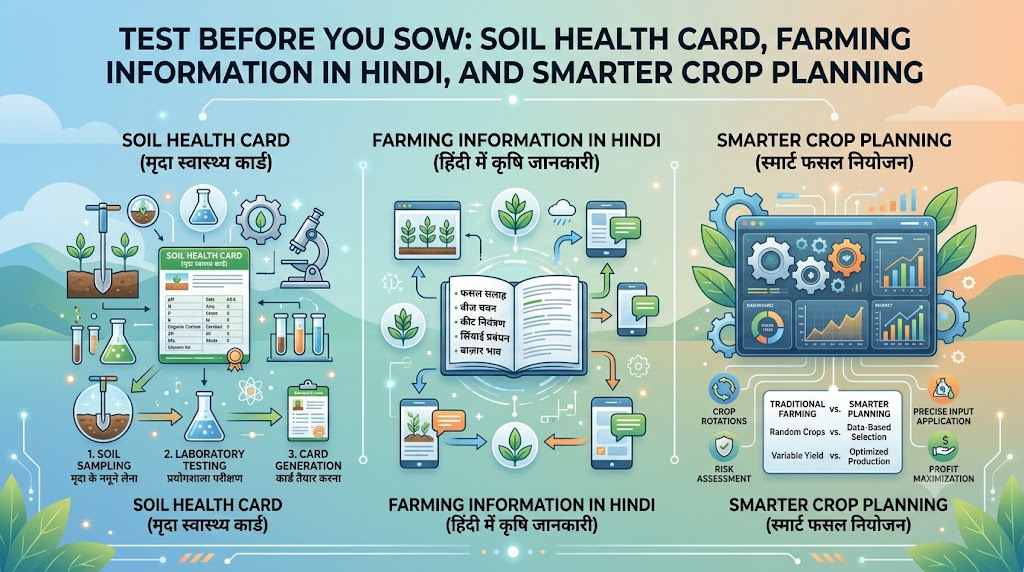
Many farmers add fertilizer by habit. A neighbour used a certain bag, so they buy the same one. The crop may still look weak, and money is gone. Often the missing step is a simple soil test. It tells you what your land really needs. Clear farming information in Hindi makes this step easy to understand. MAHTO is a Hindi-first rural knowledge platform. It explains agriculture, government schemes, livestock, mandi prices, and village business in plain words. It is not a government website. This blog shows why soil testing matters and how to use the results. It also covers papers, credit, crops, animals, and side income.
What Does Soil Testing Mean?
Soil testing means checking a small sample of your field soil in a lab. The lab looks at things like acidity, salt, and plant food levels. It also checks organic matter, which is the natural material that feeds the soil. The result is a short report. It says what your soil has enough of and what it lacks. Think of it as a health check for the land. You would not give medicine to a person without a check. In the same way, your field needs a check before heavy inputs.
Why This Matters for Farmers and Villages
Wrong inputs waste money and can harm the field over time. Too much of one thing may lock out another. Too little leaves the crop hungry. A test report guides you to buy only what the soil needs. That can lower costs across seasons. It also helps crops grow evenly. When a whole village tests its soil, local shops and experts can give better advice. Neighbours can compare notes and learn from each other. Careful use of inputs also protects village wells and ponds.
Farming Information in Hindi: Why Simple Language Helps
A lab report is full of strange terms. Words like pH, nitrogen, and electrical conductivity confuse many readers. Farming information in Hindi explains them in daily speech. pH simply shows whether soil is sour or bitter. Nitrogen helps leaves grow green. Once you know this, a report turns into a plan. You can ask the agriculture officer sharper questions. Family members can read the report together and decide. Clear language also stops shopkeepers from selling items you do not need. Still, ask local experts before you act.
Government Schemes for Farmers
Among government schemes for farmers, the Soil Health Card is the best match for this topic. It gives a farmer a report on the soil of a specific field. The report also carries advice on balanced use of inputs. Some states run testing camps or labs close to villages. Others support compost making or water saving. Rules, places, and timing differ by state. Ask your block agriculture office how to get your soil tested. MAHTO.IN explains scheme basics, documents, and common mistakes in easy steps. Use it to prepare, and let the office confirm the rest.
PM Kisan eKYC Explained Simply
Soil care costs money, and steady support helps. If you receive PM-Kisan support, keep your PM Kisan eKYC complete. It is an online identity check that confirms the right person receives the benefit. Check your status on the official portal. Make sure your name, bank account, and mobile number match your papers. Land records also matter for soil testing, since a report is tied to a field. Fix any mismatch early. A common service centre can help if you get stuck. Steps may change, so follow the official portal. Never share an OTP.
Kisan Credit Card: What Farmers Should Know
A Kisan Credit Card can help with input costs once you know what your soil needs. Banks set the limit, interest, and repayment dates. You may need ID, address proof, and land papers. Ask the branch to explain every charge. A test report can help you plan a leaner shopping list. That means you may need less credit. Borrow only for what the crop truly needs. Repay when the harvest sells. Rules differ by bank, so confirm current terms at the branch.
How to Check Mandi Prices
Soil care should connect to market planning. Before you pick a crop, learn how to check mandi prices for your options. Use official market portals, mandi boards, and trusted traders. Compare rates across several weeks. A crop that sells well last season may not do so again. Match what your soil supports with what buyers want. Better soil often gives better grain quality, which can improve offers. Write the rates in a notebook, and subtract carrying costs. Then decide with a clear mind.
How to Grow Paddy
Paddy also responds to soil condition. If you plan how to grow paddy, test the field first. Some soils hold water well, while others drain fast. Salty or very acidic soil needs special care, and your agriculture office can guide you. Level the field and choose a suitable variety. Raise seedlings in a nursery bed and transplant them on time. Keep water steady and remove weeds early. Use the Soil Health Card advice when you plan fertilizer. Do not guess amounts. Ask local experts for exact guidance.
How to Start Organic Farming
Soil is the heart of natural farming. If you wonder how to start organic farming, a soil test is the right first move. It shows how much organic matter your land already holds. Then you can plan compost and green manure. Mix finished compost into the soil, and let raw manure rot first. Grow pulses in rotation, since they help feed the next crop. Keep a notebook of what you add and what you harvest. Results come slowly. Learn label rules before you sell anything as organic.
How to Start Goat Farming
Goat manure can enrich your soil, so this link is worth knowing. Here is how to start goat farming with soil in mind. Build a dry, raised shed with a floor that is easy to clean. Collect droppings in a covered pit and let them age. Use the finished compost on one plot at a time. Keep clean water ready. Pick a breed suited to your climate. Begin with a few healthy animals. A local veterinarian should guide vaccines and illness. Never treat animals without expert advice.
Livestock Farming Information
Good livestock farming information shows how animals and soil support each other. Cow dung feeds compost pits. Poultry droppings are strong and need ageing before use. Fish pond silt can sometimes enrich nearby fields, but check with local experts first. Animals need balanced feed, and the fodder you grow depends on your soil. Vaccines protect against common diseases, and a veterinarian sets the schedule. Keep animal sheds clean so that waste can be handled safely. Choose animals your family can look after daily.
Village Business Ideas
Soil care opens useful village business ideas. A family can make and sell compost in small bags. Another can run a vermicompost unit using farm waste. Some youth groups can learn to collect soil samples and guide neighbours on how to submit them. A nursery can grow seedlings for gardens and farms. Others may offer simple tool rental for field preparation. Check local rules before you offer any testing service. Start small and test demand. Count your own labour as a cost. No idea guarantees profit.
Table: Farming and Rural Income Options at a Glance
| Option | What It Involves | Who It Helps |
|---|---|---|
| Government schemes for farmers | Soil Health Card and testing camps | Farmers planning inputs |
| PM Kisan eKYC | Online identity check and matching land records | PM-Kisan beneficiaries |
| Kisan Credit Card | Bank credit planned around a test report | Farmers needing seasonal funds |
| How to check mandi prices | Matching crop choice with market demand | Growers choosing what to sow |
| How to grow paddy | Field care guided by soil condition | Farmers with irrigated land |
| How to start organic farming | Compost plans based on organic matter levels | Farmers building soil |
| How to start goat farming | Manure for compost and a dry, clean shed | Families with small space |
| Livestock farming information | Using animal waste safely on fields | Mixed farming families |
| Village business ideas | Compost bags, vermicompost, nursery | Youth, women, small groups |
Common Mistakes Farmers Make
- Skipping the soil test. Without it, input use is guesswork.
- Taking a sample from one spot only. Collect from several places in the field.
- Mixing samples from different fields. Each field needs its own report.
- Ignoring the Soil Health Card advice. Read it and follow local guidance.
- Leaving PM Kisan eKYC pending. Support may pause.
- Taking a larger Kisan Credit Card loan than needed. A test report may lower your costs.
- Choosing a crop without learning how to check mandi prices first.
- Trusting shop advice on government schemes for farmers without verifying it.
- Using raw manure on young plants. Let it rot before use.
- Forgetting to test again after a few seasons. Soil changes over time.
A Simple Example
This is a fictional example. A family farms a small plot and keeps a few goats. Their crop has looked weak for two seasons. They read soil guides on MAHTO and decide to test before buying inputs. At the agriculture office, they ask how to submit a sample. They collect soil from several spots and keep each field separate. When the report arrives, they ask an officer to explain it. They then plan inputs on a smaller shopping list. They also start a compost pit using goat droppings. Every step is checked with a local office.
How MAHTO Can Help
MAHTO.IN helps families make better soil and crop choices. Its farming pages cover crops, irrigation, soil testing, fertilizers, pest control, and calendars, including how to grow paddy and how to start organic farming. Scheme pages explain PM-Kisan, PM Fasal Bima Yojana, Kisan Credit Card, and Soil Health Card. They share eligibility, benefits, documents, application steps, and common mistakes. Livestock pages offer livestock farming information on dairy, poultry, fish, goats, and feed. Business pages share village business ideas for many budgets. The goal is farming information in Hindi that is clear and practical. MAHTO.IN is not an official portal. It cannot promise income, subsidy, or loan approval.
Frequently Asked Questions About Soil Testing and Crop Planning
- How does farming information in Hindi help me read a soil report?
It explains terms like pH and nitrogen in daily words. You can then see what your soil lacks. Family members can discuss the report together. Still, ask your agriculture officer to confirm the advice, since local soil and crops differ. - How do government schemes for farmers help with soil care?
The Soil Health Card gives a report for your field with advice on balanced input use. Some states also run testing camps and compost support. Ask your block agriculture office what is open now. Never pay anyone for a promised approval. - Does PM Kisan eKYC affect soil testing?
Not directly. But clean land and identity records help in every scheme process. If you receive PM-Kisan, complete eKYC on the official portal. Match your name, bank account, and mobile number. A common service centre can help if needed. - Can a Kisan Credit Card be planned using a soil report?
Yes, a report may help you list only the inputs you need. That can keep your loan smaller. Ask the bank about limits, interest, and repayment dates. Bring ID, address proof, and land papers. Approval is never guaranteed. - How to check mandi prices before choosing a crop?
Use official market portals, mandi boards, and trusted traders. Track rates for several weeks. Compare nearby markets. Match the crop to what your soil supports. Subtract transport costs. Then choose with a clear plan. - Should I test soil before I learn how to grow paddy in a new field?
Yes, it is a good habit. A report shows if the soil is too salty or too acidic. Ask your agriculture office how to read it. Choose seed suited to your area. Follow local advice for fertilizer, and never guess amounts. - What should I know first about how to start organic farming?
Test your soil, then begin on one small plot. Build fertility with compost and green manure. Keep notes on every input. Expect slow results. Ask local experts about training and label rules before you sell produce as organic. - How to start goat farming and use the manure well?
Build a dry shed and collect droppings in a covered pit. Let them age before use. Start with a few healthy animals. Meet a veterinarian before you buy. Keep records of feed and health. Grow slowly after you learn the routine. - Where can I read reliable livestock farming information about manure and compost?
Ask your agriculture office and veterinary office. Farm training centres also help. Plain guides on MAHTO.IN can prepare your questions. Always age manure before field use. Ask a veterinarian before treating any animal. - Does MAHTO share village business ideas related to soil and compost?
Yes, MAHTO shares simple village business ideas such as compost bags and seedling nurseries. It is a Hindi-first learning platform, not a government site. It cannot promise income. Try any idea on a small scale first.
Final Thoughts
Healthy soil is the base of every good season. Test before you spend, and read your report with an expert beside you. Keep your land records and PM Kisan eKYC in order. Plan inputs carefully, and use a Kisan Credit Card only for real needs. Learn how to check mandi prices before you pick a crop. Skills like how to grow paddy, how to start organic farming, and how to start goat farming all gain from better soil. Use farming information in Hindi, steady livestock farming information, and practical village business ideas to plan. Confirm government schemes for farmers on official sources. MAHTO will keep sharing simple guides for rural families.
Leave a Reply