The Strategic Anatomy of Multidomain Operations: An Educational Guide
Introduction
Modern conflict rarely presents itself neatly in a single environment. Instead, contemporary security environments demand that defense organizations operate simultaneously across land, maritime, air, space, and cyberspace. The conceptual answer to this systemic challenge is multidomain operations, a strategic and operational framework designed to link disparate operating capabilities into a cohesive unit. For defense scholars, policy researchers, and military history students, grasping how these distinct environments interact is essential to understanding 21st-century national security architecture.This comprehensive overview examines the theoretical foundation, structural challenges, and technological drivers of multidomain operations. We will analyze the essential connections between command systems, information networks, logistics networks, and operational planning. Educational resources at WarOpsX.com offer valuable tools for students and analysts seeking to dissect these organizational frameworks through an objective, academic lens.
Understanding the Core Concept of Multidomain Operations
At its essence, multidomain operations describe a shift from isolated domain management to complete functional synchronization. Defense analysts categorize operational environments into five distinct domains: land, maritime, air, space, and cyberspace (which encompasses the broader electromagnetic and information landscape).
               [ NATIONAL DEFENSE OBJECTIVES ]
                              │
              +---------------┴---------------+
              │   Multidomain Operating Model │
              +---------------┬---------------+
                              │
  ┌─────────────┬─────────────┼─────────────┬─────────────┐
  │             │             │             │             │
  ▼             ▼             ▼             ▼             ▼
[ Land ]   [ Maritime ]    [ Air ]      [ Space ]     [ Cyber ]
  │             │             │             │             │
  └─────────────┴──────┬──────┴─────────────┴─────────────┘
                       │
       [ CROSS-DOMAIN CONVERGENCE & SYNCHRONIZATION ]
The goal of multidomain operations is not simply to fight in multiple environments simultaneously, but to achieve cross-domain convergence. This occurs when an initiative generated in one domain (such as a cyber maneuver) creates a window of operational advantage in an entirely different domain (such as physical land maneuver or maritime access).
Core Definitions
- Operational Domain: An organized sphere of activity recognized by defense institutions as having distinct physical, technical, or regulatory characteristics.
- Deconfliction: Establishing spatial, temporal, or frequency boundaries to ensure friendly capabilities do not interfere with each other.
- Synchronization: Coordinating operational actions across space and time to achieve a focused, cumulative effect.
- Cross-Domain Convergence: The rapid alignment of cross-environmental capabilities to present complex, multi-layered challenges to an opposing force.
- Systemic Resilience: The organizational and technical capacity to absorb shock, adapt to disruptions, and maintain operational functionality across all domains.
Historically, military organizations operated largely within domain silos, treating air power, ground forces, and naval fleets as distinct elements that coordinated periodically. Multidomain theory alters this model by framing space-based sensors, software networks, and physical platforms as parts of a continuous, single operational canvas.
Strategic Importance in Defense Studies
In academic strategic studies, multidomain operations are analyzed as a structural response to geopolitical changes and technological acceleration. Strategic thinking centers on how states balance limited national resources to achieve long-term security goals while minimizing exposure to systemic risk.
Categorizing Strategy, Operations, and Tactics
To evaluate modern defense doctrine, researchers draw clear boundaries between three recognized tiers of analysis:
- Strategic Level: Formulates grand strategy, defines national policy objectives, manages defense budgets, forms international alliances, and shapes long-term capability development.
- Operational Level: Translates high-level strategic guidance into campaigns by organizing force elements, managing theater logistics, and allocating cross-domain resources.
- Tactical Level: Focuses on the immediate engagements, movement techniques, and platform-level mechanics executed by small units.
Multidomain concepts operate primarily at the strategic and operational levels. Strategists evaluate how investments in non-kinetic infrastructure—such as satellite constellations, encrypted communication arrays, and automated network defense—support long-term deterrence and maintain strategic options across diverse contingencies.
Integrating Command and Control Systems
Command and Control (C2) serves as the brain and nervous system of any defense enterprise. Command establishes authority, policy guidelines, legal accountability, and strategic intent. Control provides the technological infrastructure, operational processes, and reporting channels that allow leaders to direct complex organizations.
+-----------------------------------------------------------------+
|               COMMAND & CONTROL ARCHITECTURE                   |
+-----------------------------------------------------------------+
| Strategic Intent   -->   Establishes Priorities & Policy Rules  |
| Information Layer  -->   Aggregates Data Across All 5 Domains   |
| Operational Control-->   Distributes Guidance to Joint Units    |
+-----------------------------------------------------------------+
Modernizing Decision Structures
Classical military hierarchies were designed around vertical chains of command tailored to individual service branches. Because data moves instantly across digital networks, modern C2 systems must transition toward federated, highly integrated structures:
- Mission Command: Empowering subordinate commanders to act flexibly within established strategic boundaries when communication channels are disrupted.
- Data Aggregation & Synthesis: Utilizing centralized processing hubs to clean, filter, and correlate raw sensory input into unified operational pictures.
- Network Redundancy: Constructing command channels that automatically shift data pathways across satellite, terrestrial, airborne, and subsurface links when localized networks suffer outages.
Intelligence, Surveillance, and Reconnaissance (ISR)
Maintaining clear situational awareness across five domains requires continuous data collection and rapid analytical synthesis. Intelligence, Surveillance, and Reconnaissance (ISR) provides the sensory apparatus that informs strategic planning and command decision-making.
Key Components of ISR
- Intelligence: The refined, evaluated, and contextualized analytical product generated by interpreting raw information.
- Surveillance: Persistent, systematic monitoring of designated geographic zones, orbital planes, electronic frequencies, or software networks.
- Reconnaissance: Focused, mission-specific tasks executed to answer targeted questions regarding specific environmental or operational conditions.
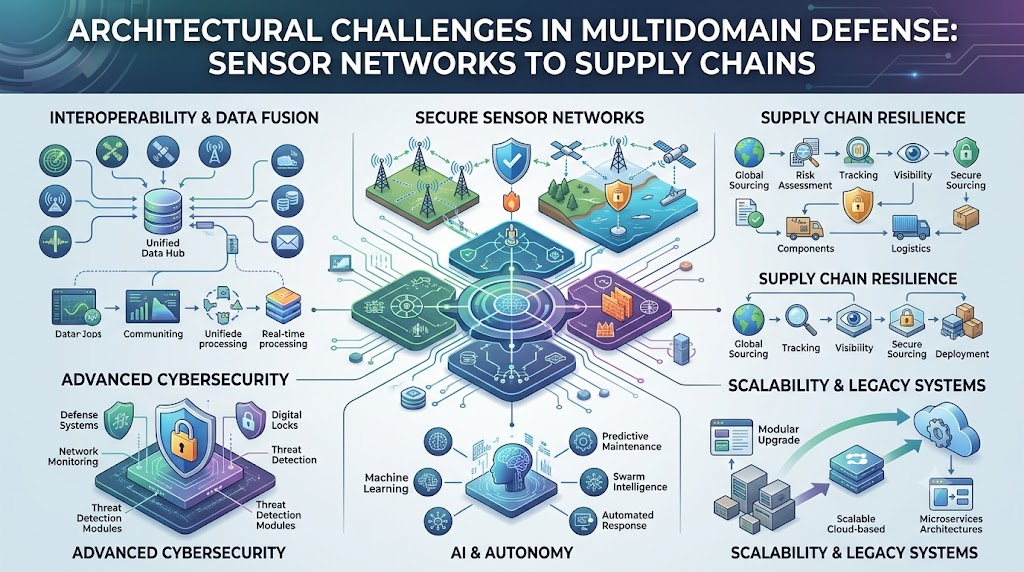
In a multidomain environment, ISR platforms must transmit information across domain boundaries in real time. For example, orbital radar satellites, maritime acoustic arrays, high-altitude aerial platforms, and network traffic monitors feed continuous streams of raw telemetry into unified processing hubs. The central challenge for ISR analysts is managing information overload—extracting meaningful strategic insights from massive volumes of noise without creating analytical bottlenecks.
Defense Technology and System Dynamics
Technological innovation serves as a primary engine driving multidomain integration. Defense analysts evaluate technology not as a panacea, but as an operational variable that creates both distinct capabilities and new vulnerabilities.
Key Technological Drivers
- Automated Data Processing: Algorithmic tools designed to aggregate, organize, and prioritize vast streams of telemetry for human decision-makers.
- Unmanned Platform Integration: Autonomous and semi-autonomous systems across air, surface, sub-surface, and ground environments capable of continuous environmental monitoring.
- Resilient Orbital Networks: Distributed satellite constellations in low Earth orbit that provide global communication coverage and position-navigation-timing support.
- Cyber-Electromagnetic Capabilities: Tools that protect data integrity, secure software architecture, and manage access to the electromagnetic spectrum.
Systemic Limitations and Policy Frameworks
Technology cannot eliminate the fundamental friction of security environments. High-technology networks remain vulnerable to hardware wear, physical infrastructure damage, software vulnerabilities, and environmental interference. Policy researchers also evaluate the ethical dimensions of technology adoption, including legal constraints under international law, human oversight of automated systems, privacy protections, and space sustainability standards.
Military Logistics and Sustainment Across Domains
While modern strategic theory frequently emphasizes digital connectivity and data processing, physical organizations cannot function without continuous logistical support. Logistics remains the ultimate operational constraint.
+-----------------------------------------------------------------+
|                  MULTIDOMAIN LOGISTICS MATRIX                   |
+-----------------------------------------------------------------+
| Physical Supply  --> Fuel, Munitions, Food, Hardware Replacements |
| Digital Support  --> Software Updates, Cyber Security Hardening  |
| Infrastructure   --> Ports, Airfields, Power Plants, Rail Links  |
+-----------------------------------------------------------------+
Contemporary Logistics Challenges
- Disrupted Supply Corridors: Strategic planners must assume that transport routes—whether maritime shipping routes, ground lines of communication, orbital relays, or network backbones—will face disruption in a crisis.
- High-Tech Supply Chains: Complex modern defense platforms require specialized global supply networks for critical components like microchips, rare earth elements, and advanced composite materials.
- Software and Network Sustainment: Modern sustainment includes maintainers updating digital platforms, applying security patches, and preserving network bandwidth alongside traditional mechanical repairs.
Building resilient logistics systems requires modular supply structures, pre-positioned equipment, standardized joint components, alternative energy distribution, and durable partnerships with commercial industrial bases.
Military Organizational Structure and Joint Forces
To execute cross-domain strategy, defense institutions must align their organizational structures, moving away from isolated service cultures toward fully integrated joint force models.
Organizational Architecture
- National Defense Headquarters: Sets long-term policy priorities, manages budgetary allocations, and oversees force development across all services.
- Joint Operational Commands: Geographic or functional headquarters responsible for integrating land, maritime, air, space, and cyber forces within a specific theater.
- Specialized Functional Commands: Organizations tasked with enterprise-wide responsibilities, such as strategic transport, space architecture, or network defense.
Organizational Comparison Matrix
| Structure Model | Core Emphasis | Operational Strength | Structural Vulnerability |
| Traditional Branch (Isolated) | Single-domain expertise (e.g., naval doctrine) | Specialized expertise and focused tactical training | Poor inter-service communication and bureaucratic rigidity |
| Joint Task Force | Operational co-location of branch assets | Improved cooperation across traditional domain boundaries | Administrative overhead and complex command chains |
| Multidomain Integrated Enterprise | Continuous cross-domain convergence and data sharing | High operational adaptability and dynamic resource allocation | Extreme technical dependencies and high data management burdens |
Historical and Conceptual Frameworks
Historical Precedents: Air-Sea-Land Integration in the Pacific (1942–1945)
Long before digital networks existed, strategic planners faced multi-environmental challenges during the Pacific Campaign of World War II. Achieving strategic goals required the continuous alignment of naval fleets, amphibious ground forces, land-based and carrier-based air power, submarine operations, signal intelligence, and vast maritime supply chains. Victory depended on coordinating actions across air, sea, and land domains, highlighting the timeless strategic need for multi-environment synchronization.
Conceptual Paradigm Shift: Cold War Operational Theories
During the 1970s and 1980s, military theorists recognized that linear ground warfare models were insufficient for defense planning in Central Europe. Concepts such as the AirLand Battle doctrine linked ground maneuvers directly with deep air interdiction operations. This theoretical shift laid the groundwork for modern multidomain operations by establishing that deep-operational depth (air) and close-operational depth (land) form an interconnected, continuous operational space.
Hypothetical Scenario: Cross-Domain Network Resilience
Consider a hypothetical defense system managing a joint surveillance task force across a coastal region:
      [ Space Satellites ]           [ Aerial Radar Units ]
                │                              │
                └──────────────┬───────────────┘
                               │
                               ▼
               +-------------------------------+
               | Regional Data Synthesis Hub   |
               +-------------------------------+
                               │
                               ▼
              [ Automated Network Re-router ]
                               │
                ┌──────────────┴──────────────┐
                ▼                             ▼
   (Primary Link Damaged)        (Backup Optical Fiber Route)
                │                             │
                ▼                             ▼
        [ System Retains Real-Time Situational Awareness ]
During a system test, extreme solar atmospheric activity disrupts primary satellite communications. Because the organization utilizes an integrated multidomain architecture, system controllers immediately reroute incoming telemetry through airborne relays and underground fiber networks. Situational awareness remains uninterrupted, demonstrating how structural redundancy mitigates cross-domain vulnerability.
Strategic Analysis Framework
Students and policy researchers can utilize this eight-step structural framework to objectively analyze defense concepts and multi-environment operational plans:
Step 1: Identify Policy Objectives
   │
Step 2: Map Key Organizations & Actors
   │
Step 3: Evaluate Constraints & Resource Limits
   │
Step 4: Assess Information Architecture & C2 Systems
   │
Step 5: Review Logistics & Supply Chain Resilience
   │
Step 6: Analyze Technical Interoperability
   │
Step 7: Evaluate Risk, Friction, & Uncertainty
   │
Step 8: Contextualize Within History & Policy
- Identify Policy Objectives: Determine the overarching political, strategic, or security goal governing the enterprise.
- Map Key Organizations and Actors: Catalog the participating military services, coalition partners, civil agencies, and non-state actors.
- Evaluate Constraints and Resource Limits: Identify physical geography, financial budgets, force structures, and industrial constraints.
- Assess Information Architecture and C2: Examine how data flows between sensors, command hubs, and field units across all operational domains.
- Review Logistics and Supply Chain Resilience: Analyze the physical and digital infrastructure required to sustain operations over extended periods.
- Analyze Technical Interoperability: Determine whether communication protocols, hardware standards, and software architectures align across different force elements.
- Evaluate Risk, Friction, and Uncertainty: Identify systemic single points of failure, potential miscalculations, and vulnerabilities to operational disruption.
- Contextualize Within History and Policy: Assess how international law, domestic legal frameworks, treaty obligations, and historical precedents influence the strategy.
Common Misconceptions
- Misconception 1: Multidomain operations rely entirely on advanced digital technology.
- Correction: While digital systems accelerate data exchange, multidomain operations are fundamentally an organizational and strategic approach centered on decision-making, force structure, leadership, and operational synchronization.
- Misconception 2: Operating across more domains automatically guarantees strategic success.
- Correction: Expanding operational reach into new domains introduces structural complexity, increases resource demands, and creates new potential failure points that must be managed.
- Misconception 3: Cyber and space capabilities have rendered physical mass irrelevant.
- Correction: Non-physical domains enable, inform, and support physical maneuver, but they do not replace the fundamental requirement to secure physical territory, ports, airfields, and industrial infrastructure.
- Misconception 4: Command and control is strictly a technology hardware problem.
- Correction: Effective C2 depends primarily on clear organizational relationships, sound strategic doctrine, human judgment, legal authority, and adaptable operational frameworks.
Key Takeaways
- Multidomain operations coordinate capabilities across land, maritime, air, space, and cyberspace to achieve unified strategic objectives.
- Cross-domain convergence occurs when initiatives executed in one domain create operational advantages in another environment.
- Resilient Command and Control (C2) systems require decentralized decision-making frameworks coupled with redundant communication networks.
- Intelligence, Surveillance, and Reconnaissance (ISR) provides the observational baseline for multi-environment operational planning.
- Physical logistics, industrial supply chains, and maintenance support remain essential constraints on cross-domain capabilities.
- Rigorous strategic analysis requires balancing technological opportunities against policy parameters, ethical considerations, and organizational friction.
Frequently Asked Questions
What is the core focus of multidomain operations?
Multidomain operations focus on synchronizing activities across land, sea, air, space, and cyberspace. By integrating capabilities across these physical and non-physical environments, modern defense organizations aim to create dynamic operational options, overcome complex strategic challenges, and maintain systemic resilience across all operational spheres.
How do multidomain operations build upon legacy joint operations?
Legacy joint operations primarily focused on deconflicting spatial and temporal boundaries between army, navy, and air forces. Multidomain operations go further by continuously integrating space, cyber, and information operations alongside conventional forces, allowing actions in non-physical domains to directly enable maneuvering in physical environments.
What are the five domains studied in modern defense frameworks?
The five recognized operational domains are land, maritime, air, space, and cyberspace. Defense researchers analyze how activities within each environment interact, evaluate how technical systems communicate across domain lines, and study how strategic leaders coordinate actions within this unified operating landscape.
Why is command and control essential to multidomain strategy?
Command and control systems provide the organizational logic, legal guidelines, and communication channels necessary to process data. In a multidomain context, effective C2 ensures that vast sensor networks feed clear information to decision-makers without causing data bottlenecks or administrative paralysis.
What is the distinction between surveillance and intelligence in ISR?
Surveillance refers to the persistent, systematic monitoring of geographic areas, communication frequencies, or orbital paths. Intelligence is the final analytical product created after raw surveillance data is processed, evaluated, contextualized, and interpreted by analysts to answer specific strategic questions.
What logistical challenges are unique to high-tech multidomain systems?
High-tech systems require complex global supply networks for microelectronics, specialized technical maintenance, continuous software updates, and high-capacity electrical power generation. Additionally, modern logistics planners must protect both physical transport routes and digital communication networks from operational disruption.
What is cross-domain convergence?
Cross-domain convergence refers to the deliberate, rapid integration of capabilities across different operational environments to create compound dilemmas for an opposing system. An example includes using cyber network actions to disable radar systems, thereby opening a safe corridor for air and maritime maneuver.
How does space architecture support ground-based operations?
Space systems supply vital infrastructure for position-navigation-timing (GPS), global communications, weather monitoring, and strategic early warning. These satellite networks provide the observational precision and continuous data links required for ground and naval forces to operate over vast geographic distances.
Why does strategic studies examine historical campaigns when evaluating modern defense systems?
Historical campaigns offer clear empirical case studies showing how organizations adapt to environmental friction, command challenges, and supply limits. Studying past joint operations helps researchers identify enduring patterns in human leadership, resource allocation, and organizational behavior that modern technology does not eliminate.
Where can students access educational resources on strategic defense concepts?
Students, policy analysts, and researchers can consult academic journals, institutional reports, defense studies archives, and educational sites such as WarOpsX.com, which provides clear, structured educational content covering strategic thinking, military history, command systems, and technology trends.
Conclusion
Mastering the conceptual framework of multidomain operations requires an analytical approach that connects national strategic goals with organizational structure, emerging technology, logistical realities, and information management. As international security contexts become more complex, studying how land, maritime, air, space, and cyber environments interact provides critical clarity for students of strategic studies. Academic destinations like WarOpsX.com are dedicated to providing clear, objective research resources that help scholars, policy learners, and defense enthusiasts analyze these complex defense frameworks responsibly and effectively.
Leave a Reply