Engineering Automated Data Pipelines: CI/CD, Quality Controls, and Observability
Introduction
Modern analytics environments suffer when data teams are forced to operate as firefighters. Silent ETL job failures, unexpected schema changes, missing records, and brittle custom scripts create systemic bottlenecks that delay critical business intelligence. When data delivery relies on manual interventions or static cron jobs, engineering organizations waste valuable capacity diagnosing broken downstream workloads.
Transitioning to Data Pipeline Automation addresses these operational flaws at the source. By embedding core DataOps methodologies—such as version-controlled configurations, programmatic workflow orchestration, automated validation, and continuous deployment—data platforms transform into predictable, resilient systems.
Whether you are an individual practitioner sharpening your data engineering skills or an enterprise team migrating toward modern data delivery, mastering automation is essential. Knowledge hubs like TheDataOps.org offer practical insights for navigating this transition. This article outlines the architectural mechanics, evaluation criteria, and operational frameworks necessary to implement production-ready pipeline automation.
Understanding Data Pipeline Automation in Modern DataOps
At its core, data pipeline automation replaces manual execution with programmatic management across every stage of the data lifecycle. Rather than relying on human triggers or static server configurations, automated pipelines run dynamically based on time intervals, incoming system events, or upstream task completion.
Legacy data architectures often treated ETL jobs as isolated scripts running on unmonitored servers. Upgrades required manual server updates, and quality failures were usually reported by end users looking at broken dashboards.
+-----------------------------------------------------------------------------------+
|                        LEGACY UNMANAGED PIPELINE FLOW                             |
|  [Static Server Job] -> [Unchecked Script] -> [Manual Push] -> [Unnoticed Failure] |
+-----------------------------------------------------------------------------------+

+-----------------------------------------------------------------------------------+
|                       AUTOMATED DATAOPS PIPELINE FLOW                             |
|  [System Event] -> [CI/CD Deployment] -> [Orchestrator] -> [Data Validation]       |
|                       -> [Telemetry & Alerts] -> [Target Lake/Warehouse]           |
+-----------------------------------------------------------------------------------+
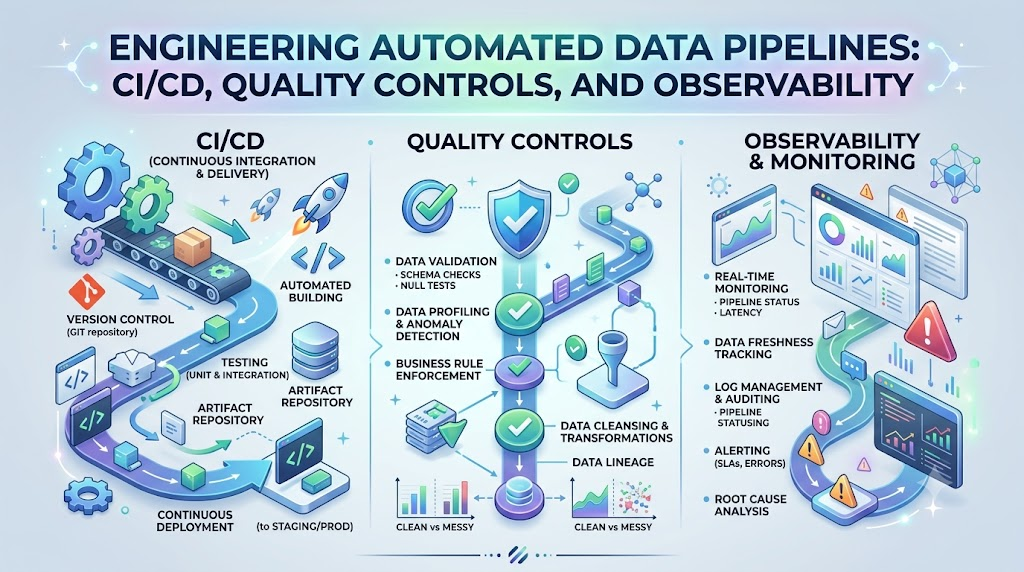
A modern DataOps workflow applies software engineering rigors to data movement. Code artifacts live in centralized repositories, modification steps run through automated validation, and incoming payloads undergo schema checks before reaching production tables.
Pillars of Programmatic Pipelines
- Code-Defined Orchestration: Managing execution dependencies, run windows, and retry routines using software code rather than point-and-click interfaces.
- Inline Data Validation: Running dynamic tests (e.g., integrity constraints, field range checks, non-null guarantees) prior to updating core target models.
- Continuous Integration & Delivery (CI/CD): Automatically executing test suites and deploying code changes across development, staging, and production environments.
- Self-Healing Architectures: Implementing intelligent retry logic, dead-letter routing, and automated failover paths to navigate transient network or compute outages.
The Operational Foundation: DataOps Principles
DataOps is an operational philosophy combining concepts from Agile methodologies, DevOps practices, and Lean manufacturing to reduce development cycle times while keeping data quality high.
Iterative Delivery Over Big-Bang Launches
Rather than spending months engineering a single massive data load, DataOps encourages small, continuous releases. Iterative deployments allow teams to gather early feedback, isolate code defects faster, and adapt quickly to shifting business requirements.
Removing Organizational Friction
Automated data pipelines establish a standardized operational contract between data authors (application developers), platform engineers, and data consumers (analysts and data scientists). Automated deployment gates and uniform testing suites prevent miscommunications and lower operational risk across teams.
Layered Architecture for Automated Pipelines
An enterprise DataOps framework uses a modular architecture where each layer handles a specific task in the data lifecycle.
+-----------------------------------------------------------------------------------+
|                            DATAOPS SYSTEM ARCHITECTURE                            |
|                                                                                   |
|  1. Ingestion Layer       -> Event streaming & scheduled batch collection         |
|  2. Processing Layer      -> Transformation, normalization, & enrichment          |
|  3. Orchestration Layer   -> Dependency graphs, retries, & execution control      |
|  4. Quality Guardrails    -> Assertions, schema validation, & constraint checks   |
|  5. Observability Engine  -> Telemetry, freshness, drift, & anomaly tracking      |
|  6. Target Storage        -> Cloud data warehouses, lakes, & feature repositories |
|  7. CI/CD & Security      -> Git integration, automated testing, RBAC, & auditing |
+-----------------------------------------------------------------------------------+
- Ingestion Layer: Captures raw batch files, CDC (Change Data Capture) logs, and streaming events from databases, queues, and third-party APIs.
- Processing Layer: Executes transformations, joins, and aggregation routines using distributed engines or in-warehouse SQL models.
- Orchestration Layer: Tracks dependency trees, ensuring downstream jobs execute only after upstream prerequisites succeed.
- Quality Guardrails: Inspects incoming records against pre-established quality assertions before committing updates.
- Observability Engine: Captures telemetry regarding execution latency, row volume variations, schema shifts, and processing errors.
- Target Storage: Stores structured and unstructured datasets in cloud warehouses, data lakes, or feature stores for consumption.
- CI/CD & Security Layer: Controls infrastructure state, manages access permissions, and automates code testing and deployment cycles.
How DataOps Compares to Adjacent Disciplines
Clarifying the boundaries between DataOps and related technical domains helps clarify operational roles across the enterprise.
| Discipline | Primary Focus | Representative Toolset | Key Deliverables |
| DataOps | Operational health, pipeline automation, & data reliability | Airflow, dbt, Git, Great Expectations, Soda, CI/CD runners | Reliable execution, dynamic validation, pipeline telemetry |
| Data Engineering | System architecture, pipeline design, & storage optimization | Python, SQL, Apache Spark, Snowflake, Databricks, Kafka | Schema models, ETL/ELT pipelines, target storage structures |
| DevOps | Application lifecycle management & infrastructure provisioning | Docker, Kubernetes, Terraform, Jenkins, GitHub Actions | Container runtimes, cloud environments, application deployments |
| MLOps | Machine learning model lifecycles, training, & drift management | MLflow, Kubeflow, Feast, Python, PyTorch | Deployed ML endpoints, feature stores, drift alerts |
| Platform Engineering | Internal self-service developer portals & cloud primitives | Kubernetes, Crossplane, Terraform, Backstage | Standardization templates, automated cloud infrastructure |
Core Mechanics of Automated Data Pipelines
Building production-grade automation requires integrating four fundamental operational functions: orchestration, deployment, validation, and telemetry.
1. Code-Based Orchestration
Modern workflow orchestrators construct processing steps as Directed Acyclic Graphs (DAGs) written in actual programming code, making task management fully versionable and reproducible.
Python
# Conceptual Orchestration DAG in Python
from airflow import DAG
from airflow.operators.python import PythonOperator
from datetime import datetime

def extract_source_payloads():
    print("Ingesting raw payloads from source endpoints...")

def enforce_quality_rules():
    print("Executing assertion checks on raw staging tables...")

def publish_to_warehouse():
    print("Promoting verified records to production schema...")

with DAG(
    dag_id="dataops_automated_ingestion",
    start_date=datetime(2026, 1, 1),
    schedule_interval="@hourly",
    catchup=False,
) as dag:

    step_extract = PythonOperator(task_id="extract_source", python_callable=extract_source_payloads)
    step_quality = PythonOperator(task_id="enforce_quality", python_callable=enforce_quality_rules)
    step_publish = PythonOperator(task_id="publish_warehouse", python_callable=publish_to_warehouse)

    # Programmatic dependency chaining
    step_extract >> step_quality >> step_publish
2. Continuous Delivery for Data Platforms
Implementing CI/CD practices across data workflows requires:
- Tracking transformation models, configuration parameters, and infrastructure definitions in Git.
- Automatically running unit tests and SQL syntax validations on every Pull Request.
- Deploying verified updates smoothly across non-production and production environments.
3. Automated Quality Verification
Quality suites serve as automated gateways, ensuring bad data does not corrupt analytical models. Standard checks include:
- Null Pointer Prevention: Ensuring critical keys and identity attributes are populated.
- Uniqueness Constraints: Guaranteeing duplicate entries are flagged and handled.
- Schema Integrity: Verifying incoming data types match target table definitions.
- Value Boundary Audits: Ensuring numeric metrics remain within expected domain boundaries.
4. Operational Data Observability
While system monitoring measures server uptime, Data Observability measures the operational health of the data moving through those systems across five key dimensions:
                  +-----------------------------------+
                  |      THE 5 DIMENSIONS OF          |
                  |     DATA OBSERVABILITY            |
                  +-----------------------------------+
                                    |
     +-----------------+------------+------------+------------------+
     |                 |                         |                  |
+----+----+      +-----+-----+             +-----+-----+      +-----+-----+
| Data    |      | Volume    |             | Schema    |      | Lineage   |
| Timeliness|    | Stability |             | Tracking  |      | Mapping   |
+---------+      +-----------+             +-----------+      +-----------+
                                    |
                             +------+------+
                             | Value       |
                             | Correctness |
                             +-------------+
- Timeliness: Is data arriving within configured SLAs?
- Volume Stability: Are row counts within historical standard deviations?
- Schema Tracking: Has an upstream system modified column structures without warning?
- Lineage Mapping: How does a pipeline failure affect downstream dashboards and reports?
- Value Correctness: Are distribution profiles shifting unexpectedly?
Tooling Ecosystem for Modern DataOps
Choosing the right technology stack requires understanding how different tool categories handle specific parts of the operational pipeline.
+-----------------------------------------------------------------------------------+
|                         DATAOPS TOOLING CATEGORIES                                |
|                                                                                   |
|  Orchestration        : Apache Airflow, Prefect, Dagster                          |
|  Processing/ETL       : dbt, Apache Spark, Ray                                    |
|  Ingestion/CDC        : Apache Kafka, Airbyte, Fivetran                           |
|  Data Quality         : Great Expectations, Soda, dbt-expectations                |
|  Observability        : Monte Carlo, Databand, OpenLineage                        |
|  CI/CD & Provisioning : GitHub Actions, GitLab CI, Terraform, Docker              |
+-----------------------------------------------------------------------------------+
Orchestration Platforms
- Apache Airflow: An open-source orchestrator offering extensive integration options and programmatic Python control.
- Prefect & Dagster: Modern alternatives engineered with first-class dynamic execution, data-aware asset models, and streamlined local testing capabilities.
Transformation & Processing
- dbt (data build tool): Standardizes SQL-based transformations inside cloud warehouses, providing native support for testing, versioning, and documentation generation.
- Apache Spark: A compute engine designed for distributed transformations across large volumes of structured or unstructured datasets.
Validation & Observability Frameworks
- Great Expectations: An open-source framework used to profile, document, and enforce data quality constraints.
- Monte Carlo & Databand: Platforms providing automated anomaly detection, lineage mapping, and incident management across enterprise data environments.
Applied Scenarios in Pipeline Automation
The following scenarios highlight how automation changes operational outcomes in everyday data engineering.
Scenario 1: Automated Quarantining on Raw Data Ingestion
Context: An organization receives daily vendor transaction files via cloud storage. Previously, malformed records frequently caused downstream data warehouse loads to fail midway through execution.
Automated Workflow:
- An object upload event triggers an automated ingestion workflow.
- The orchestrator runs an inline quality suite prior to data promotion.
- The validation engine evaluates field types, non-null requirements, and transaction value ranges.
- Valid records proceed directly to production tables.
- Invalid rows route automatically to a quarantine dataset, while a structured diagnostic alert notifies the data on-call engineer via Slack.
Scenario 2: Automated Testing via CI/CD for Transformation Changes
Context: A developer updates the business logic in an existing customer lifetime value (CLV) calculation.
Automated Workflow:
- The developer submits a pull request containing modified SQL models.
- The CI pipeline initiates an automated build:
- Compiles code and verifies SQL syntax.
- Provisions isolated staging schemas in the warehouse.
- Executes the updated transformations against test data and asserts quality rules.
- Once tests pass and approval is granted, code merges to the primary branch.
- The deployment engine updates the production environment without manual server management.
Implementation Roadmap for DataOps Teams
Adopting data pipeline automation works best through an incremental roadmap rather than a full system overhaul.
+-----------------------------------------------------------------------------------+
|                        STEP-BY-STEP ADOPTION ROADMAP                              |
|                                                                                   |
|  [Phase 1: Audit Current Pipelines] ---> [Phase 2: Version Control Everything]    |
|                                                                    |              |
|  [Phase 4: Programmatic Orchestration] <-- [Phase 3: Automated Quality Assertions]|
|         |                                                                         |
|         v                                                                         |
|  [Phase 5: Implement CI/CD Pipelines] -> [Phase 6: Deploy Telemetry & Alerts]    |
+-----------------------------------------------------------------------------------+
- Phase 1: Assess System Health: Document legacy jobs, identify unmonitored scripts, catalog manual dependencies, and calculate current failure rates.
- Phase 2: Put Everything in Git: Ensure all transformation logic, database migrations, and pipeline configurations live in version control.
- Phase 3: Add Quality Assertions: Introduce basic data tests (non-null, unique key, schema integrity) at critical ingestion points.
- Phase 4: Standardize Orchestration: Migrate static cron scheduling to a centralized, code-driven orchestration platform.
- Phase 5: Automate Deployment Pipelines: Build automated CI/CD checks to validate and deploy code changes across non-production and production environments.
- Phase 6: Deploy Observability & Telemetry: Implement automated volume tracking, SLA monitoring, and lineage generation to shorten incident resolution times.
- Phase 7: Review and Refine: Run post-incident reviews regularly to update test suites and improve system design continuously.
Pitfalls and Operational Challenges
Common Challenges
- Legacy System Constraints: Mainframe databases and legacy enterprise systems often lack modern API integrations or CDC support, requiring custom adapter pipelines.
- Cross-Team Silos: Software engineering teams often modify application schemas without considering downstream data engineering dependencies.
- Skill Adaptation: Shifting from manual GUI interfaces to automated, code-driven DataOps requires data teams to adopt modern software development practices.
Key Pitfalls to Avoid
- Automating Flawed Logic: Automating a poorly structured pipeline simply accelerates failure generation. Clean up transformation logic and data models before automating execution.
- Notification Fatigue: Alerting on non-critical metrics causes teams to ignore alerts. Keep automated notifications actionable and tied to business-impacting issues.
- Confusing Tools with Process: Buying orchestration software or observability tools without establishing clear versioning, testing, and ownership practices will not fix unreliable data operations.
- Neglecting Documentation: Unregistered dataset dependencies increase troubleshooting time during system outages. Maintain automated lineage and dataset documentation.
Decision Framework for Tool Selection
Use this structured decision framework when evaluating DataOps tooling or platform components:
- Identify the Core Operational Need: Determine whether your immediate priority is job scheduling, dataset testing, telemetry tracking, or continuous deployment.
- Evaluate Technical Alignment: Ensure candidate technologies match your team’s existing skill sets (e.g., Python-native tools versus SQL-centric platforms).
- Assess Infrastructure Compatibility: Verify native integration capabilities with your target storage layers, cloud data warehouses, and ingestion sources.
- Determine Scaling Limits: Evaluate how candidate platforms perform under heavy parallel workloads and dynamic resource provisioning.
- Review Security Safeguards: Confirm native support for Secrets Management, Role-Based Access Control (RBAC), SSO, and compliance audit logging.
- Conduct a Focused Proof of Concept (PoC): Build a small end-to-end pipeline to evaluate developer ergonomics, debugging capabilities, and operational maintenance requirements.
Security, Governance, and Compliance Standards
Automated pipelines must handle sensitive corporate data securely and remain fully compliant with regulatory standards.
- Credential Management: Never hardcode credentials, database connections, or API keys in repository code. Inject secrets at runtime using secure key management services.
- Access Control Policies: Enforce strict Role-Based Access Control (RBAC) across orchestrators, deployment runners, and underlying data stores.
- PII Masking Routines: Implement automated transformation steps to anonymize, hash, or redact personally identifiable information (PII) before loading data into non-production environments.
- Audit and Compliance Logs: Keep comprehensive lineage logs, deployment records, and data access histories to satisfy auditing requirements such as SOC 2, GDPR, and HIPAA.
Emerging Landscape in Data Pipeline Automation
DataOps practices continue to advance alongside cloud infrastructure innovations and machine learning capabilities.
- Data Contracts: Formal, code-enforced interface specs between application developers and data platforms. Data contracts validate structural compliance before software changes disrupt downstream data pipelines.
- Metadata-Driven Execution: Modern orchestrators use dynamic runtime metadata to build execution flows on the fly, auto-scaling compute resources based on incoming payload sizes.
- Platform Engineering Integration: Data platform teams are encapsulating infrastructure into internal developer platforms (IDPs), giving data engineers standardized self-service templates to launch secure pipelines.
- AI-Assisted Operations: Machine learning models are increasingly used to detect data volume anomalies automatically, suggest validation thresholds, and optimize resource allocation for complex transformations.
Educational Support via TheDataOps.org
Building resilient, production-grade automated pipelines requires a solid understanding of software engineering, platform architecture, and operational testing. Specialized learning resources like TheDataOps.org help professionals master these concepts by providing practical educational material on workflow orchestration, CI/CD design patterns, data quality management, and enterprise DataOps architecture.
By prioritizing software discipline, automated testing, and proactive telemetry, organizations can build predictable, self-healing data environments that deliver continuous business value.
Practical Takeaways
- Automation Restores Trust: Programmatic orchestration and inline assertions eliminate silent failures and deliver predictable data updates.
- Treat Data Workflows like Software: Apply core software development practices—including version control, peer reviews, CI/CD testing, and modular design—to all pipeline code.
- Catch Errors Early: Implement automated validation checks at ingestion boundaries to prevent malformed data from reaching downstream data models.
- Monitor the Data, Not Just Servers: Deploy comprehensive data observability to track volume anomalies, schema shifts, latency SLAs, and end-to-end lineage.
- Refine Workflows Iteratively: Automation is an ongoing process. Use post-incident reviews to continuously expand testing suites and improve system resilience.
Frequently Asked Questions (FAQs)
1. What is the main goal of Data Pipeline Automation?
Data pipeline automation replaces manual execution with programmatic triggers, automated testing, orchestration, and continuous delivery. It aims to improve data reliability, accelerate release cycles, and eliminate silent failures in analytical environments.
2. How does DataOps differ from traditional data engineering?
Traditional data engineering focuses primarily on writing custom code to move and transform data. DataOps adds software engineering discipline—such as automated testing, version control, CI/CD, dynamic orchestration, and telemetry—to make those pipelines repeatable and reliable.
3. What tools are core to an automated DataOps stack?
Standard tools include Apache Airflow, Prefect, or Dagster for orchestration; dbt for SQL transformations; Great Expectations or Soda for data quality assertions; Monte Carlo for observability; and GitHub Actions or GitLab CI for continuous deployment.
4. What is the difference between system monitoring and Data Observability?
System monitoring tracks infrastructure health like CPU load, memory usage, and execution status. Data Observability inspects the health of the dataset itself, evaluating freshness, volume variations, schema drift, field distributions, and lineage maps.
5. Why is version control critical for data automation?
Storing pipeline code, SQL models, and infrastructure definitions in Git allows teams to track changes over time, perform code reviews, automate test executions via CI pipelines, and quickly revert breaking changes in production systems.
6. How do automated data quality gates operate?
Quality gates run programmatic assertions against incoming records during ingestion or transformation. If records violate rules (e.g., non-null constraints, unique key checks, or range thresholds), the pipeline isolates bad records or pauses execution before corrupting downstream tables.
7. What are Data Contracts and why are they used?
Data Contracts are formal, code-enforced specifications between software developers who generate data and data engineers who process it. They enforce schema structures and SLA terms upfront, preventing upstream app changes from breaking downstream data pipelines.
8. Is pipeline automation beneficial for small data engineering teams?
Yes. Automation reduces manual, repetitive operational tasks, allowing small teams to maintain complex, reliable data architectures without spending time constantly firefighting broken pipelines.
9. What is the role of workflow orchestration in automated platforms?
Workflow orchestrators coordinate task execution sequences, manage execution dependencies, execute automatic retries upon failure, pass runtime state parameters, and issue operational notifications across complex data workflows.
10. What is the recommended first step in adopting DataOps?
Start by placing all existing transformation code, SQL scripts, and pipeline configurations into a version control repository like Git. From there, implement basic automated quality tests on critical ingestion pathways before expanding to advanced orchestration and observability tools.
Conclusion
Data Pipeline Automation is essential for modern enterprise data engineering. Replacing brittle, manual processes with code-driven orchestration, continuous deployment, automated testing, and proactive observability creates a stable foundation for corporate analytics.Achieving data operational excellence requires combining modern software practices with strong data architecture principles. Learning platforms like TheDataOps.org support engineers and architecture teams along this path by providing practical, accurate educational resources to master automated data operations.
Leave a Reply