QuantumOps in Modern IT: Essential Skills, Quantum Tools, Training, and Professional Development
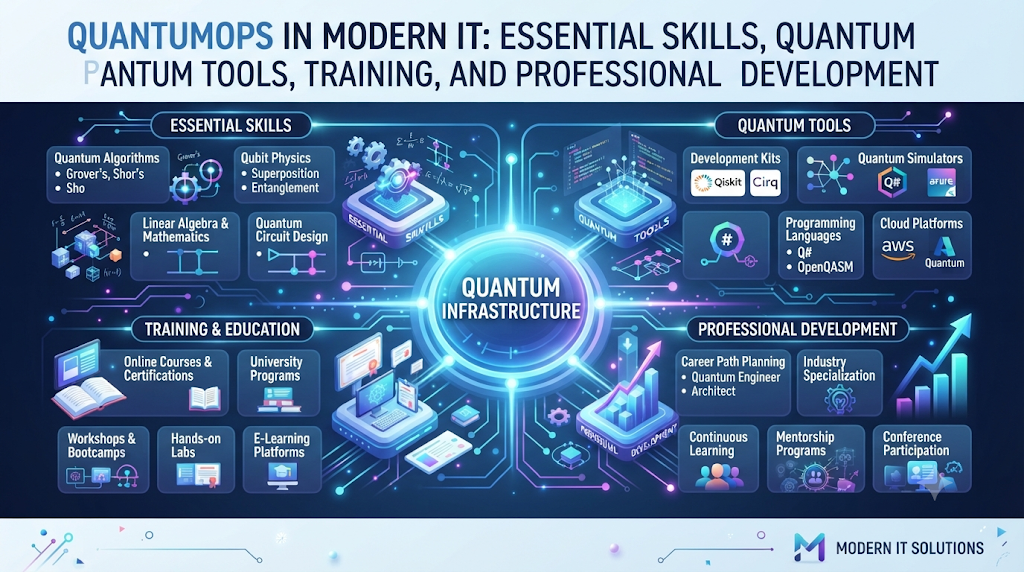
Introduction
Technology teams face new challenges as computing methods change. Quantum computing is becoming one area of technical interest. Developers, cloud engineers, and system architects are exploring it. IT managers also want to understand its possible uses. However, quantum technology needs careful study and clear planning.
QuantumOps connects quantum computing with software development and IT operations. It brings together programming, cloud environments, system design, and technical planning. QuantumOps School is a specialized education, certification, and consulting platform. It is based in India and promotes online and classroom training. Its learning areas help professionals explore quantum concepts through structured study. This includes tools, practical exercises, and technical topics.
What Is QuantumOps?
QuantumOps refers to the work involved in studying and managing quantum computing environments. It connects quantum software, computing hardware, cloud access, and technical operations. The term can have different meanings across organizations.
Traditional IT operations focus on software, servers, networks, and cloud systems. QuantumOps adds knowledge about quantum systems to this wider area. It helps technical teams understand quantum programs and their working methods.
Quantum computers use qubits instead of regular computer bits. A qubit is the basic unit of quantum information. A normal bit stores either zero or one. A qubit can represent a combination of possible states.
This idea is called superposition. Entanglement describes a special connection between quantum states. A quantum gate changes the state of a qubit. A quantum circuit combines gates into a planned sequence.
These concepts help explain how quantum programs work. They also show why quantum computing needs different learning methods. Quantum systems are not simple versions of normal computers.
Quantum computing remains early-stage. Today’s quantum computers have noise and other technical limits. Noise means unwanted changes in quantum information. Error correction means methods for finding and managing errors.
QuantumOps does not mean replacing traditional IT systems. Classical computers remain useful for most everyday tasks. Researchers and companies are exploring selected quantum applications. Their practical value depends on the problem and technology.
Why Organizations Are Exploring QuantumOps
Organizations need to understand new technologies before making technical decisions. QuantumOps gives teams a way to study quantum computing. It can help them understand its basic ideas and limits.
Software developers can explore quantum programming methods. Cloud engineers can study online quantum environments. System architects can review hardware and software connections. Researchers can explore quantum algorithms and experiments.
Quantum computing for software engineers introduces a different way of processing information. Developers can learn how circuits and gates work. They can also study the role of measurements.
Quantum computing for IT managers supports technology awareness. Managers can learn about possible uses and technical risks. This knowledge can help them review project plans.
Organizations should not treat quantum computing as an immediate business solution. Many tasks still run better on classical computers. Quantum projects need clear goals and careful technical review.
QuantumOps can help teams build basic knowledge. It can also support discussions about learning needs. However, training cannot promise savings, faster systems, or business growth.
Quantum Cloud Computing Training for Technical Teams
Quantum cloud computing training helps learners study quantum environments through cloud platforms. It introduces online access to quantum computing tools. Learners can explore circuits and software-based simulations.
A simulator is a program that models quantum system behavior. It lets learners test ideas without using physical quantum hardware. This can help beginners understand circuit operations.
Quantum cloud computing training can cover several learning areas:
- Basic quantum computing terms.
- Cloud-based quantum environments.
- Qubit and circuit concepts.
- Quantum programming workflows.
- Simulator-based exercises.
- Result interpretation.
- Basic workload planning.
Cloud-based learning can help people study from different locations. It can also introduce quantum computing without owning hardware. However, access depends on the relevant platform.
QuantumOps School advertises cloud-based quantum computing in its curriculum. Its listed learning tools include AWS Braket, IBM Quantum, and Azure Quantum. These are learning platforms, not official training partnerships.
Quantum cloud computing training should also explain hardware limitations. Learners need to understand the difference between simulations and physical systems. This helps them form realistic expectations.
Quantum Computing for Software Engineers
Software developers often work with code, data, and system logic. Quantum computing introduces another way to process information. Developers can begin by studying its basic building blocks.
Quantum computing for software engineers focuses on qubits and quantum operations. Learners study how gates change quantum states. They also learn how circuits combine these operations.
A quantum circuit works like a planned set of instructions. Each gate performs an operation on one or more qubits. Measurement provides information about the final state.
Important learning areas include:
- Differences between bits and qubits.
- Superposition and entanglement.
- Quantum gate operations.
- Circuit construction.
- Measurement and probability.
- Basic quantum algorithms.
- Simulator practice.
Quantum computing for software engineers also requires a change in thinking. Normal programs often follow familiar step-by-step instructions. Quantum programs use different rules for information and measurement.
Developers should understand concepts before copying code. This makes programming practice more useful. It also helps them understand technical errors.
QuantumOps School advertises programming and algorithm topics. Its curriculum lists tools such as Qiskit and Cirq. It also includes Microsoft Quantum Development Kit.
Quantum Programming Tools Used in QuantumOps
QuantumOps learning can include several programming frameworks and cloud platforms. Each tool supports a different part of quantum learning. The main goal is understanding the ideas behind the tools.
1. Qiskit
Qiskit is a tool used for quantum programming. Learners can explore quantum circuits and operations. A Qiskit programming course generally teaches circuit building and measurement. It may also include simulator practice.
2. Cirq
Cirq is a framework for quantum programming. It helps learners explore circuits and quantum operations. Students can use practical exercises to understand programming concepts.
3. Microsoft Quantum Development Kit
Microsoft Quantum Development Kit is a tool for quantum development and learning. It introduces programming concepts related to quantum systems. QuantumOps School lists it among its curriculum tools.
4. AWS Braket
AWS Braket is a cloud-based quantum computing platform. AWS Braket training introduces learners to cloud quantum workflows. It can help them study how quantum tasks fit into an online environment.
5. IBM Quantum
IBM Quantum is a platform listed in the advertised curriculum. Learners can study quantum computing concepts through its learning environment. They should check current platform information before use.
6. Azure Quantum
Azure Quantum is another platform covered in the learning topics. It gives learners another area to explore. Course coverage depends on the provider’s current syllabus.
A Qiskit programming course can introduce circuit-based programming. AWS Braket training can introduce cloud quantum workflows. Both areas require an understanding of quantum basics.
QuantumOps learning should not focus only on software names. Learners need to understand qubits, gates, circuits, and noise. These ideas provide the base for tool practice.
Qiskit Programming Course for Practical Learning
A Qiskit programming course helps learners explore quantum programming through practical exercises. It generally begins with basic circuit concepts. Students then study gates and measurements.
The course may cover:
- Basic quantum programming concepts.
- Creating simple circuits.
- Applying quantum gates.
- Measuring quantum states.
- Running circuits on simulators.
- Understanding returned results.
- Reviewing simple programming examples.
Learners should understand each circuit operation. They should know what a gate does. They should also study how measurements produce results.
A Qiskit programming course may include simulator exercises. Where access is available, learners may also study real-device execution. Actual access depends on the platform and program.
QuantumOps School advertises Qiskit as part of its learning curriculum. Its listed training formats include practical labs and simulations. Students should check the current syllabus before enrollment.
AWS Braket Training for Cloud-Based Quantum Learning
AWS Braket training introduces the general process of exploring quantum computing through cloud environments. It helps learners understand the connection between cloud services and quantum workflows.
A cloud quantum service provides an online way to explore quantum computing resources. Learners can study how programs prepare and submit quantum tasks. They can also review the results.
AWS Braket training may include:
- Quantum computing fundamentals.
- Cloud quantum concepts.
- Circuit preparation.
- Simulator-based exercises.
- Workflow planning.
- Result interpretation.
This subject can interest cloud engineers and software developers. It introduces quantum computing as another technical learning area.
Learners should understand that cloud access does not remove hardware limits. Quantum systems still face noise and other challenges. Many computing tasks remain more suitable for classical systems.
QuantumOps School advertises AWS Braket within its learning topics. The platform is independent. It does not claim official affiliation with Amazon Web Services.
Hybrid Quantum Classical Computing Training
Hybrid quantum classical computing training explains how traditional and quantum systems can work together. Each system has a different role. A classical computer may handle regular processing. A quantum system may perform a selected operation.
Hybrid computing means combining two computing approaches. A workflow can prepare information on a classical system. It can then send a suitable task to a quantum environment. The classical system can review the returned information.
Hybrid quantum classical computing training may cover:
- Classical and quantum system roles.
- Data preparation.
- Quantum circuit execution.
- Result processing.
- Workflow connections.
- Basic error handling.
This approach matters because current quantum hardware has limits. Classical computers still perform most everyday computing work. Hybrid systems allow researchers to explore selected quantum operations.
Teams must also consider data movement and security. They should understand which parts remain classical. They should review system requirements before planning integration.
QuantumOps School advertises hybrid quantum-classical systems in its curriculum and consulting areas. Organizations should review the advertised service scope. No technical or business outcome is guaranteed.
Quantum Computing Architecture Course for System Planning
A quantum computing architecture course explains the structure of quantum systems. It covers the relationship between hardware, software, and cloud environments.
Architecture means the design and organization of a system. Quantum architecture includes physical components and software operations. It also covers how different parts connect.
A quantum computing architecture course may cover:
- Qubit fundamentals.
- Quantum hardware architecture.
- Quantum software layers.
- Circuit design.
- Cloud-based quantum environments.
- Workload optimization.
- Error correction concepts.
Quantum hardware architecture helps learners understand physical quantum systems. It explains the role of hardware in quantum operations. It also introduces the limits that affect system use.
Error correction focuses on detecting and managing errors. It matters because noise can affect quantum information.
QuantumOps School lists hardware architecture and quantum error correction among its advertised learning topics. These subjects can help professionals study system design.
Quantum Computing for IT Managers
Quantum computing for IT managers focuses on awareness and planning. Managers do not need to become quantum programmers. They should understand the main concepts and limits.
Managers may need to study:
- Quantum computing basics.
- Possible research applications.
- Hardware and software limitations.
- Security and data concerns.
- Team learning needs.
- Project planning.
- Vendor and trainer evaluation.
Quantum computing for IT managers also involves realistic expectations. Quantum systems remain early-stage. Managers should not expect guaranteed business improvements.
They should ask clear questions before approving a project. They should review the learning goals and technical scope. They should also consider whether classical computing is more suitable.
QuantumOps School advertises a Manager learning track. The track is part of its wider training offering. Managers should review the current syllabus before enrolling.
Quantum Computing Certification Course and QuantumOps Certification
A quantum computing certification course gives learners a structured way to study quantum technology. It may include lessons, practical work, and assessments.
Before choosing a course, learners should review:
- Course syllabus.
- Learning goals.
- Programming exercises.
- Simulator practice.
- Technical assessments.
- Capstone project details.
- Credential conditions.
A quantum computing certification course should explain what learners will study. It should also describe how their knowledge will be assessed.
QuantumOps certification refers to credentials advertised by QuantumOps School. The platform promotes four learning and certification tracks.
Architect Track: Focuses on quantum architecture and system design.
Engineer Track: Covers technical learning, programming, and circuits.
Manager Track: Focuses on technology awareness and planning.
Professional Track: Provides a wider learning path for technology professionals.
QuantumOps certification details should be checked directly with the provider. Ask about the syllabus, exams, and assessment process. Also ask whether the credential fits your needs.
Do not assume that the credential has external accreditation. Do not assume employer or technology vendor recognition. A certificate does not guarantee a job or promotion.
Quantum Computing Consulting Services for Organizations
Quantum computing consulting services generally help organizations study quantum-related technical needs. They may involve system planning, integration, and development discussions.
QuantumOps School advertises the following consulting areas:
- Quantum cloud integration.
- Algorithm development.
- Workload optimization.
- Hybrid quantum-classical systems.
- Cloud security.
- Implementation strategy.
The platform also advertises access to freelance support. Organizations should check the exact scope before making commitments.
Before hiring, ask what work is included. Confirm the responsibilities and expected deliverables. Discuss data security and technical requirements. Review the limits of the proposed service.
Quantum computing consulting services cannot guarantee business benefits. Results depend on the project and organization. Quantum technology remains early-stage.
Table: QuantumOps Skills and Learning Options
| Option | What It Covers | Who It Helps |
|---|---|---|
| Quantum cloud computing training | Cloud environments and simulators | Cloud engineers |
| Qiskit programming course | Circuits and quantum programming | Developers |
| AWS Braket training | Cloud quantum workflows | Cloud professionals |
| Hybrid quantum classical computing training | Combined computing methods | Technical teams |
| Quantum computing architecture course | Hardware and system design | Architects |
| Quantum computing certification course | Lessons and assessments | New learners |
| QuantumOps certification | Four advertised learning tracks | IT professionals |
| Quantum computing consulting services | Integration and planning support | Organizations |
| Quantum computing for IT managers | Risk and project awareness | Managers |
Common Mistakes People Make When Learning QuantumOps
1. Expecting immediate business results: Quantum computing remains early-stage. Results are not guaranteed.
2. Ignoring basic concepts: Learn qubits and circuits before advanced programming.
3. Replacing classical computing: Traditional computers remain important for daily work.
4. Learning tools without understanding them: Programming tools cannot replace basic knowledge.
5. Ignoring hardware noise: Noise can affect quantum information and results.
6. Assuming certificates guarantee jobs: Credentials do not promise employment or promotion.
7. Overlooking cloud security: Teams should review data and access requirements.
8. Hiring without checking service details: Confirm responsibilities and project scope.
9. Confusing simulations with real hardware: Simulators do not prove physical device performance.
10. Trusting every technology claim: Check evidence and technical limitations.
Practical Example: A Team Starts Exploring QuantumOps
Fictional Example: A Small Software and Cloud Team
Imagine a software team that manages cloud applications. Its members want to understand quantum computing. They decide to begin with basic learning.
The developer studies qubits and quantum circuits. Next, the developer explores a Qiskit programming course. Simulator exercises help explain circuit operations.
The cloud engineer studies quantum cloud computing training. The engineer also reviews AWS Braket training concepts. This introduces cloud-based quantum workflows.
The system architect studies a quantum computing architecture course. The manager explores quantum computing for IT managers. Both review technical needs and possible risks.
The team also studies hybrid quantum classical computing training. Members discuss how classical and quantum systems differ. They do not assume that quantum computing suits their current applications.
The team reviews QuantumOps School’s advertised learning tracks. It checks the course syllabus and practical training formats. The members choose their learning goals carefully.
This fictional example shows a learning process. It does not promise business improvements or technical results.
How QuantumOps School Supports Learning and Development
QuantumOps School is an independent education, certification, and consulting platform based in India. It promotes online and classroom training.
The site advertises four tracks: Architect, Engineer, Manager, and Professional. Its listed topics include qubits, quantum gates, superposition, entanglement, algorithms, hardware architecture, error correction, and workload optimization.
Its advertised curriculum includes Qiskit, Cirq, Microsoft Quantum Development Kit, AWS Braket, IBM Quantum, and Azure Quantum.
The platform advertises instructor-led sessions, practical labs, simulations, case studies, technical assessments, and capstone projects.
Its advertised consulting and freelance support areas include cloud integration, algorithm development, workload optimization, hybrid systems, cloud security, and implementation strategy.
QuantumOps School also publishes articles and tutorials. These cover quantum basics, hardware, cloud platforms, programming frameworks, quantum security, and infrastructure operations.
Learners should check current course details and credential terms. Organizations should confirm the scope of any consulting service.
Frequently Asked Questions About QuantumOps
1. What is the main purpose of QuantumOps?
QuantumOps connects quantum computing knowledge with IT-related work. It includes programming, cloud environments, architecture, and technical planning. It helps professionals understand quantum systems and their limits. Its meaning can vary between organizations.
2. Who should join quantum cloud computing training?
Quantum cloud computing training may suit developers, cloud engineers, and researchers. It introduces online quantum environments and simulators. Learners can explore circuits and basic workflows. Previous experience with quantum hardware is not needed for basic study.
3. Can beginners study quantum computing for software engineers?
Quantum computing for software engineers can be studied by beginners with basic programming knowledge. Start with qubits and gates. Then explore circuits and measurements. Simple examples can help explain unfamiliar concepts.
4. What skills does a Qiskit programming course develop?
A Qiskit programming course introduces circuit creation and quantum operations. Learners study gates, measurements, and simulator exercises. It can help developers understand the basic structure of quantum programs. Course content varies by provider.
5. What is the value of AWS Braket training?
AWS Braket training introduces cloud quantum computing workflows. It helps learners understand how quantum tasks fit into online environments. It may interest cloud professionals exploring quantum technology. Learners should check the current syllabus and platform details.
6. What is covered in hybrid quantum classical computing training?
Hybrid quantum classical computing training explains how traditional and quantum systems can work together. It covers data preparation, quantum operations, and result processing. This knowledge helps teams understand the different roles of both computing methods.
7. Why should architects consider a quantum computing architecture course?
A quantum computing architecture course explains hardware, software, and cloud connections. It introduces system structure and quantum hardware limits. Architects can use this knowledge to understand how quantum components fit into wider technical environments.
8. What should I check in a quantum computing certification course?
A quantum computing certification course should have clear learning goals and a syllabus. Review its practical work and assessments. Ask what the credential means. QuantumOps certification details should be checked directly with the provider.
9. What does quantum computing for IT managers teach?
Quantum computing for IT managers introduces basic concepts, project risks, and planning needs. It helps managers understand technical limitations. They can also review team skills and security concerns before considering quantum-related work.
10. What does QuantumOps School advertise for consulting?
QuantumOps School advertises quantum computing consulting services in cloud integration, algorithm development, workload optimization, hybrid systems, cloud security, and implementation strategy. The platform also advertises access to freelance support. Organizations should confirm service scope and understand that outcomes vary.
Final Thoughts
QuantumOps brings quantum computing into wider IT learning. It connects programming, cloud environments, architecture, and technical planning. Developers can explore circuits and tools. Cloud engineers can study quantum workflows. Managers can understand risks and system limits.
Quantum computing remains early-stage. Current systems have noise and practical challenges. Classical computers remain important for everyday operations. Learning should begin with simple concepts and useful practice. QuantumOps School advertises training, certification, and consulting options. Review its syllabus, credentials, and service details before choosing a program.
Leave a Reply