Understanding Quantum Computing: Qubits, Quantum Circuits, Algorithms, and Their Growing Role in Technology
Introduction
Computing technology continues to develop in new directions. Quantum computing is one important area of research. It uses ideas from quantum physics to process information. Unlike traditional computers, it works with quantum bits. These special units are called qubits. They behave differently from ordinary computer bits. This difference creates new ways to study difficult problems. However, quantum computing can seem confusing at first. Many technical terms make learning harder for beginners. A clear explanation helps make these ideas easier. Understanding the basics also helps readers follow new research. Quantum computing connects computer science, physics, mathematics, and technology.
Understanding the Basic Idea of Quantum Computing
Quantum computing uses principles from quantum mechanics. Quantum mechanics explains the behavior of very small particles. These include atoms, electrons, and photons. Traditional computers process information using bits. Each bit stores either zero or one. Quantum computers use qubits instead. A qubit is a basic unit of quantum information. Its state describes the probabilities of different measurement outcomes.
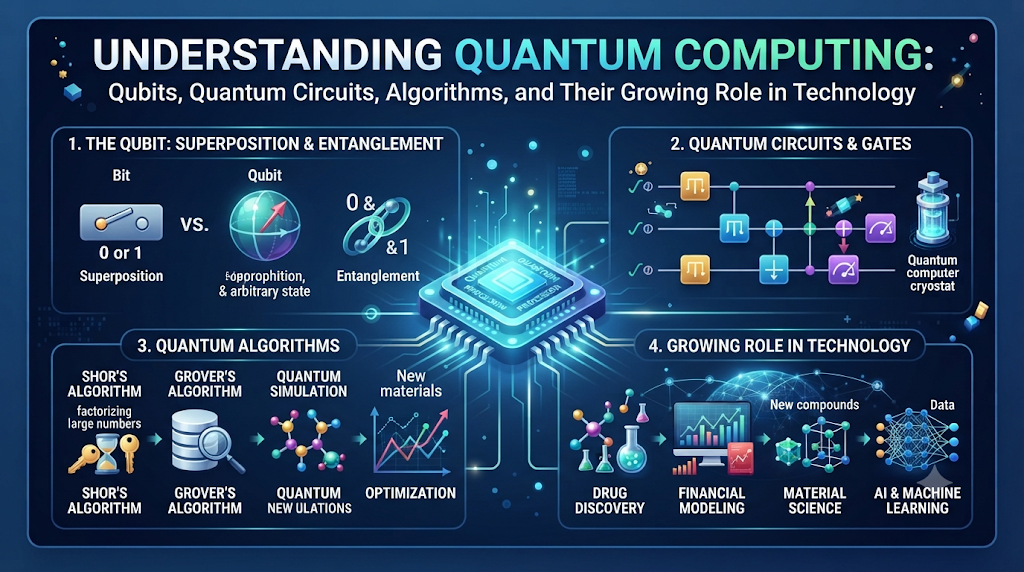
Two important quantum properties are superposition and entanglement. Superposition describes possible outcomes before measurement. Entanglement creates a strong connection between qubits. These properties help quantum computers perform special operations.
Think about a scientific research problem. Researchers may need to study complex molecules. A quantum computer could help simulate certain molecular behavior. However, this ability still requires further research.
Quantum computing does not make every calculation faster. It focuses on selected types of problems. Classical computers remain essential for everyday work.
Why Quantum Computing Matters in Modern Technology
Quantum computing brings new possibilities to computer science. It also creates important questions about digital security. Students and professionals can benefit from understanding its basic ideas.
Students can explore the connection between physics and computing. They can learn new ways to represent information. Developers can study quantum programming and circuit design.
Researchers can investigate difficult scientific problems. These include molecular behavior and material properties. Security professionals can study possible risks to encryption.
Some public-key systems depend on difficult mathematical problems. A sufficiently powerful quantum computer could affect certain systems. This makes quantum security an important research area.
However, current quantum computers have serious limits. Hardware noise can change calculation results. Researchers continue working on better error control.
Quantum Computing for Beginners
Quantum computing for beginners means learning how quantum machines process information. These machines use qubits instead of ordinary bits. They also use special operations called quantum gates.
A normal computer follows classical computing rules. It handles everyday tasks like browsing and document editing. A quantum computer has a different purpose.
It may help with selected mathematical and scientific problems. It does not automatically solve every difficult task faster. Its usefulness depends on the problem and algorithm.
For example, researchers may study molecular interactions. They can explore whether quantum methods help model these systems. This work may support future scientific research.
Beginners should understand the basic terms first. Start with qubits, superposition, and measurement. Then explore gates and circuits. This makes quantum computing for beginners easier to understand.
What Is a Qubit?
The phrase what is a qubit describes a key concept. A qubit is the basic unit of quantum information. It plays a role similar to a classical bit.
A classical bit stores zero or one. A qubit has a quantum state. This state describes the probabilities of measurement outcomes.
Superposition and Quantum States
Superposition is a property of quantum states. It allows a qubit to have possible outcomes. These outcomes can include zero and one.
A simple comparison is a spinning coin. Before it stops, its final face remains unknown. This gives a basic picture of uncertainty.
However, a qubit is not a spinning coin. Its behavior follows quantum physics. The comparison does not explain every part of superposition.
Superposition is important in quantum calculations. Quantum gates can change the state of a qubit. These changes affect the probabilities of later measurements.
Measurement in Quantum Computing
Measurement means checking a qubit’s state. The result is either zero or one. A measurement also changes the quantum state.
For example, a qubit may have equal probabilities for both outcomes. A single measurement still gives only one result. Repeated measurements can show the outcome pattern.
Understanding Entanglement
Entanglement links two or more qubits. Their shared state cannot be fully described separately. Measuring one qubit can reveal information about the shared state.
This connection does not send messages faster than light. It is a special feature of quantum information.
Learning what is a qubit helps explain quantum circuits. It also provides a base for understanding algorithms.
Quantum Computing vs Classical Computing
Quantum computing vs classical computing compares two different computing systems. Both systems process information. However, they use different information units and operations.
Classical Computers and Bits
Classical computers use bits. Each bit stores either zero or one. Logic gates perform operations on these values.
These computers support many everyday activities. Examples include online shopping, communication, gaming, and banking. They also run business software and databases.
Quantum Computers and Qubits
Quantum computers use qubits. Their states follow quantum physics. Quantum gates change these states during calculations.
A quantum circuit combines several operations. The computer measures the qubits to collect results.
Important Differences
- Information: Classical computers use bits. Quantum computers use qubits.
- Operations: Classical systems use logic gates. Quantum systems use quantum gates.
- Behavior: Classical bits have fixed values. Qubits can have quantum states.
- Uses: Classical computers handle everyday tasks. Quantum computers target selected problems.
- Development: Classical computers are widely used. Quantum computers still face hardware limits.
Quantum computing vs classical computing does not mean one system replaces another. Both systems have different strengths. They are expected to work together.
Quantum Gates Explained
Quantum gates explained refers to operations that change qubit states. These gates are important parts of quantum circuits. Each gate performs a particular operation.
Hadamard Gate
The Hadamard gate creates an even mix of measurement outcomes from a basic state. It helps prepare a qubit for later operations.
This gate is commonly studied in beginner circuits. It helps explain how superposition works.
Pauli-X Gate
The Pauli-X gate flips a basic qubit state. It changes zero to one. It also changes one to zero.
It is similar to a basic switch. However, this comparison does not cover every quantum state.
Pauli-Z Gate
The Pauli-Z gate changes a sign in the quantum state. This change can affect later circuit operations.
It does not simply flip zero into one. Its effect depends on the state and other operations.
CNOT Gate
The CNOT gate works with two qubits. It flips one qubit depending on another. One qubit controls the operation.
These gates form the building blocks of quantum circuits. Understanding quantum gates explained helps learners follow circuit operations.
Quantum Circuits Tutorial: From Qubits to Results
A quantum circuits tutorial explains how quantum gates work together. A quantum circuit is an ordered set of operations. It starts with prepared qubits and usually ends with measurement.
Preparing the Qubits
First, a circuit starts with one or more qubits. Each qubit has an initial state. This state provides the starting point.
Applying Quantum Gates
Next, the circuit applies selected gates. A Hadamard gate can create an even mix of outcomes. A Pauli-X gate can flip a basic state.
The order of gates matters. Different gate sequences can produce different final states.
Measuring the Results
After the operations, the circuit measures its qubits. Each measurement produces zero or one. The measurement changes the measured state.
Studying the Output
A quantum program can repeat the same circuit many times. The results show a pattern of outcomes. This pattern helps users study the circuit.
A quantum circuits tutorial can also include programming tools. IBM’s Qiskit is one example of a quantum framework. It helps users create and test circuits. Simulators let beginners explore circuits on classical computers.
Quantum Computing Algorithms Explained
Quantum computing algorithms explained covers methods for solving selected problems. An algorithm is a set of steps for completing a task.
Classical algorithms use ordinary computing operations. Quantum algorithms use qubits and quantum gates. Each method has a specific purpose.
Quantum Search
Quantum search focuses on finding a target item. It works with a group of possible choices. The method uses quantum operations to improve the chance of finding the target.
It does not mean checking every answer at once. It uses controlled changes to quantum states.
Quantum Factoring
Quantum factoring means finding factors of large numbers. Factors are numbers that multiply together to create another number.
This topic matters in cryptography. Some public-key systems depend on difficult factoring problems. Quantum methods may change the security of these systems.
Quantum Machine Learning
Quantum machine learning explores links between quantum computing and machine learning. Researchers study possible ways to process information through quantum methods.
Its practical value is still under investigation. More research is needed to understand its limits.
Quantum computing algorithms explained helps readers understand different problem-solving methods. It also shows why algorithms need suitable circuits.
Shor’s Algorithm Explained and Its Security Importance
Shor’s algorithm explained refers to a quantum method for finding factors of large numbers. It is an important topic in quantum computing security.
Factoring means finding numbers that multiply together. Small numbers are easy to factor. Very large numbers can be difficult for classical computers.
Some public-key systems rely on factoring or related mathematical problems. These systems help protect online communication and digital information.
Shor’s algorithm could affect certain systems if run on powerful quantum hardware. However, today’s quantum computers cannot perform this task at real encryption scale.
Running Shor’s algorithm on numbers used in real encryption needs a large, error-corrected quantum computer. Such machines do not exist today.
Quantum error correction helps protect quantum information from hardware errors. It remains a major research challenge.
Shor’s algorithm explained is important for understanding future security concerns. It does not mean current quantum computers can break encryption.
Post-Quantum Cryptography Explained for Digital Protection
Post-quantum cryptography explained means studying new encryption methods. These methods are designed to resist attacks from classical and quantum computers.
These methods run on ordinary computers. They do not need quantum hardware. This makes them different from quantum cryptography.
Quantum cryptography uses quantum physics for security tasks. Quantum key distribution is one example. Post-quantum cryptography uses mathematical methods instead.
Why Organizations Need to Understand It
Organizations store sensitive information for long periods. Some information must remain private for many years. This makes future security risks important.
Security teams need to understand where public-key systems are used. They also need to follow changes in security standards.
Standards bodies have been working on and publishing standards. These efforts support the development of quantum-resistant methods.
Readers should check current official sources for updates. For security planning, check current guidance from official standards bodies and security experts.
Post-quantum cryptography explained helps readers understand changing security needs. It also shows how quantum research connects with digital protection.
Real-World Applications of Quantum Computing
Real-world applications of quantum computing are still being studied. Researchers and companies are exploring different areas. Most uses remain in the research stage.
Chemistry and Molecular Research
Quantum computers may help researchers study molecules. Chemical systems follow quantum physics. Simulating their behavior can be difficult for classical computers.
Researchers are exploring quantum methods for molecular studies. Practical benefits still need careful testing.
Materials Science
Materials science studies the structure and behavior of materials. Researchers explore substances with useful properties.
Quantum computers may help study certain material systems. These methods remain under investigation.
Optimization Problems
Optimization means finding a suitable choice among many options. Researchers are exploring quantum methods for selected problems.
Possible areas include planning and resource allocation. No general business benefit should be assumed.
Cybersecurity Research
Quantum computing also affects digital security research. Shor’s algorithm raises concerns about some public-key systems. Post-quantum cryptography explores new protection methods.
Machine Learning Research
Researchers are studying possible links between quantum computing and machine learning. These studies explore new ways to process information.
Real-world applications of quantum computing need more testing. Current hardware still has important limits. Researchers must check results before making strong claims.
How to Learn Quantum Computing Step by Step
How to learn quantum computing starts with simple concepts. Beginners do not need advanced physics at the beginning. A clear learning path makes the subject easier.
Step One: Study Basic Concepts
Start with classical bits and qubits. Then learn superposition, measurement, and entanglement. Basic probability also helps explain possible outcomes.
Step Two: Understand Quantum Gates
Study Hadamard, Pauli-X, Pauli-Z, and CNOT. Learn what each gate changes. Focus on their purpose instead of memorizing names.
Step Three: Explore Quantum Circuits
Learn how gates form a circuit. Follow simple circuit diagrams. Understand how measurement produces results.
Step Four: Try a Programming Framework
Explore a framework such as Qiskit. It helps users create and test quantum circuits. Simulators provide a way to study basic operations.
Basic programming knowledge can help with this step. Some linear algebra also supports deeper learning.
Step Five: Study Quantum Algorithms
Explore quantum search and quantum factoring. Then study Shor’s algorithm. Understand which problems each method addresses.
Step Six: Explore Quantum Security
Learn about public-key cryptography and encryption. Study the difference between quantum and post-quantum cryptography. Explore quantum-safe protection methods.
How to learn quantum computing becomes easier with regular practice. Start with concepts before exploring advanced topics.
Quantum Computing Topics at a Glance
| Topic | What It Means | Why It Matters |
|---|---|---|
| Qubit | Basic unit of quantum information | Represents quantum states |
| Superposition | State with possible measurement outcomes | Supports quantum operations |
| Entanglement | Strong connection between qubits | Creates shared quantum states |
| Quantum gates | Operations that change qubit states | Build quantum circuits |
| Quantum circuits | Ordered quantum operations | Process quantum information |
| Quantum algorithms | Methods for selected problems | Guide quantum calculations |
| Shor’s algorithm | Quantum method for factoring numbers | Raises security concerns |
| Post-quantum cryptography | Methods designed to resist quantum attacks | Supports digital protection |
Common Mistakes People Make When Studying Quantum Computing
- Thinking qubits simply store zero and one together: Superposition describes possible measurement outcomes. It needs a proper explanation.
- Expecting quantum computers to solve every problem faster: Their usefulness depends on the task.
- Ignoring measurement: Measurement produces one result and changes the quantum state.
- Confusing entanglement with communication: Entanglement cannot send messages faster than light.
- Skipping basic concepts: Qubits and probability support advanced learning.
- Memorizing gates without studying circuits: Gates become easier to understand when studied together.
- Believing current machines can break encryption: Today’s machines cannot run Shor’s algorithm at real encryption scale.
- Mixing up quantum and post-quantum cryptography: These terms describe different security methods.
- Learning only one programming framework: Core concepts matter more than one particular tool.
- Trusting every technology claim: Check current research and official sources.
A Practical Learning Example
Fictional Example: A Computer Science Student
Imagine a student who wants to study quantum computing. The student has basic computer science knowledge. However, quantum terms seem unfamiliar.
The student starts with bits and qubits. Next, the student studies superposition and measurement. Simple examples help explain these ideas.
After that, the student explores quantum gates. The student learns how Hadamard and Pauli-X work. Then the student studies basic circuit diagrams.
The student later explores Qiskit and its simulator. This provides a way to study circuit operations. Finally, the student reads about algorithms and security.
This fictional example shows a simple learning path. It does not promise a particular result. Progress depends on study and practice.
How QuantumUting Supports Quantum Learning
QuantumUting.com is an educational technology website. Its theme is “Decoding the Quantum Future.” It explains quantum computing and quantum information science. It also covers new computing technologies in accessible ways.
The website publishes tutorials, beginner guides, technical explanations, and educational articles. Its content supports students, developers, computer science professionals, researchers, and technology fans.
Readers can explore qubits, quantum states, superposition, measurement, and entanglement. They can also study quantum gates and circuit design.
Its educational topics include Hadamard, Pauli-X, Pauli-Z, and CNOT. Quantum circuit tutorials may include examples using IBM’s Qiskit framework.
Other subjects include Shor’s algorithm, quantum search, and quantum factoring. Readers can also explore quantum software engineering and quantum machine learning.
The website covers quantum security topics too. These include post-quantum cryptography and quantum-safe encryption. Its articles also explain risks to existing public-key systems.
QuantumUting.com serves as an educational resource. It helps readers explore complex ideas through accessible explanations. Its content supports people at different learning levels.
Frequently Asked Questions About Quantum Computing
1. Can quantum computers work without classical computers?
Quantum computers can perform specialized operations. However, classical computers still support many parts of their work. They can prepare information and process results. Both systems have different roles. They are expected to work together rather than replace each other.
2. Why is quantum computing for beginners useful for computer science students?
Quantum computing for beginners introduces a different way to process information. It connects physics, mathematics, and computer science. Students can understand qubits and circuits before studying advanced topics. This knowledge also helps them follow quantum research and technology discussions.
3. What is a qubit’s role during a calculation?
A qubit stores quantum information. Its state describes possible measurement outcomes. Quantum gates change the state during a calculation. Measurement then produces one result. Multiple qubits can also become entangled and form a shared quantum state.
4. Which tasks explain quantum computing vs classical computing best?
Everyday tasks show the strengths of classical computers. These include browsing, messaging, and document editing. Scientific simulation provides an area for quantum research. Quantum computing vs classical computing compares their different methods. Neither system is better for every task.
5. How do quantum gates affect the final circuit result?
Quantum gates change the states of qubits. Their order affects later operations. Hadamard, Pauli-X, Pauli-Z, and CNOT perform different tasks. Understanding quantum gates explained helps readers follow these changes. Measurement then provides the circuit’s final output.
6. Can a quantum circuits tutorial help someone without physics knowledge?
Yes. A quantum circuits tutorial can begin with simple diagrams. Beginners can study qubit preparation, gate operations, and measurement. They can later explore Qiskit simulators. Basic programming and probability knowledge can help with practical exercises.
7. Does Shor’s algorithm explained mean encryption is already unsafe?
No. Shor’s algorithm explained describes a quantum factoring method. Running it against real encryption needs a large, error-corrected quantum computer. Such machines do not exist today. Current quantum computers cannot perform this task at real encryption scale.
8. Can post-quantum cryptography explained be understood without quantum physics?
Yes. Post-quantum cryptography explained focuses on mathematical encryption methods. These methods run on ordinary computers. They aim to resist attacks from classical and quantum computers. Readers only need basic knowledge of encryption to understand the main idea.
9. Which industries are exploring real-world applications of quantum computing?
Researchers and companies are exploring chemistry, materials science, optimization, and security. Some also study quantum machine learning. Real-world applications of quantum computing remain mostly experimental. Their practical value needs more testing. Current hardware also limits many possible uses.
10. What background is helpful when learning how to learn quantum computing?
Basic programming and probability are useful starting points. Some linear algebra can help with deeper topics. Beginners can first study qubits and quantum gates. They can then explore circuits, algorithms, and security. A step-by-step approach supports better understanding.
Conclusion
Quantum computing introduces a different way to process information. Qubits, superposition, and entanglement form its foundation. Quantum gates and circuits control quantum operations. Algorithms target selected mathematical and scientific problems. However, current quantum computers still have major limits. They are not replacements for classical computers. Their practical uses also need more research. Security teams should follow developments in quantum-safe protection. Check current guidance from official standards bodies and security experts. Learning the basic concepts creates a strong starting point. QuantumUting.com supports this learning through accessible educational articles.
Leave a Reply